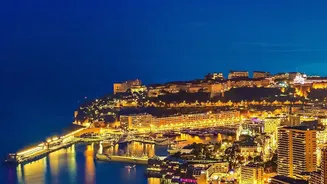






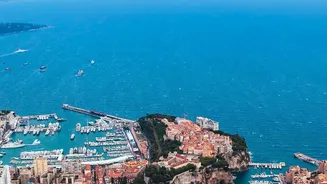
A Principality on the Brink
Monaco’s journey to becoming a tax-free paradise wasn’t born from a master plan for wealth, but from a desperate need for survival. In the mid-19th century, the principality faced a severe crisis. In 1848, the towns of Menton and Roquebrune, which were
responsible for the vast majority of Monaco's revenues through their olive, lemon, and fruit production, seceded to join France. This single event stripped the nation of over 80% of its territory and its primary source of income, pushing the monarchy toward bankruptcy. The old economic model was shattered, and Prince Charles III knew he needed a radical new vision to save his country.
A Royal Gamble on a Grand Casino
Prince Charles III’s solution was both audacious and visionary. He observed that gambling was illegal in neighbouring France and Italy, creating an untapped market. His idea was to build a luxurious casino and resort complex to attract Europe's wealthy elite. The first attempts faltered due to poor infrastructure. The turning point came when Charles III partnered with François Blanc, a savvy French casino operator. Blanc developed the world-famous Monte Carlo Casino and, crucially, helped finance a railway connecting Monaco to the rest of Europe in 1868. Suddenly, aristocrats and the newly rich had a glamorous, accessible playground, and the money began to pour in.
The 1869 Decree That Changed Everything
The success of the Monte Carlo Casino was staggering. The profits were so immense that they were sufficient to fund the entire government, the royal family, and public works. Seeing this firehose of cash from foreign visitors, Prince Charles III made a landmark decision. On February 8, 1869, he issued a sovereign order abolishing all direct personal and property taxes for the residents of Monaco. This wasn't initially a strategy to attract wealthy residents, but a practical move to reward his subjects, whose state was now fully funded by the voluntary spending of tourists. The unintended, yet powerful, consequence was that it made Monaco an incredibly attractive place for the wealthy to live.
The Modern Monaco Model
Today, Monaco still levies no income tax, capital gains tax, or wealth tax on its residents. However, it's not a complete tax-free zone. The government funds itself through a Value Added Tax (VAT), currently at 20%, which is in line with France. There is also a tax on corporate profits for businesses that generate more than 25% of their turnover outside the principality. It is also important to note a major exception: due to a 1963 treaty with France, French citizens who reside in Monaco are still required to pay French income tax. This was a concession made to prevent wealthy French citizens from simply hopping across the border to evade taxes.
More Than Just Low Taxes
While the tax advantages are the main draw, they are not the only reason one in three residents of Monaco is a millionaire. The principality offers a level of security, political stability, and luxury that is nearly unmatched. With one of the highest police-to-resident ratios in the world, it is an exceptionally safe place to live. Its location on the French Riviera, pleasant climate, and reputation for glamour continue to make it a premier destination for the world's wealthiest individuals. The initial gamble to build a casino didn’t just save the country from ruin; it created a unique, modern brand of high-end living that continues to thrive more than 150 years later.