




A Sweet Discovery in Deep Space
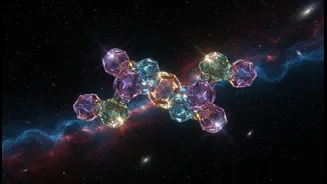
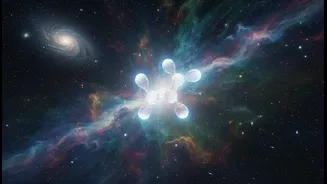
In a breakthrough for astrobiology, an international team of scientists has detected a sugar molecule called erythrulose floating in a giant molecular cloud near the center of our Milky Way galaxy. This isn't the same sugar you stir into your coffee,
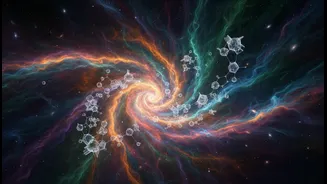
but it’s a close relative. Erythrulose is a four-carbon sugar that, on Earth, is found in things like raspberries. The discovery, made in a star-forming region known as G+0.693-0.027 some 27,000 light-years away, marks the first time a “true sugar” has been identified in the vast, cold space between star systems. This suggests that the chemical factories of the cosmos are capable of producing surprisingly complex molecules, ones that are crucial for life as we know it.
More Than Just a Grain of Sugar
While scientists have found sugar-like molecules in space before, this detection is different. In 2000, astronomers found glycolaldehyde, a simpler two-carbon molecule, and have since found it in other locations. However, many chemists argue that a “true sugar” must contain at least three carbon atoms, a definition that excludes glycolaldehyde. The discovery of four-carbon erythrulose definitively crosses that threshold. It represents a significant step up in the chemical complexity observed in the raw materials from which stars and planets form. Its presence was unexpected, challenging theories that complex molecules grow slowly by adding one carbon atom at a time.
How to Find Sugar 27,000 Light-Years Away
Spotting a specific molecule across such an immense distance is a remarkable feat of cosmic detective work. The team, led by researchers at Spain's Center for Astrobiology, used powerful radio telescopes to listen for faint signals coming from the gas cloud. Molecules in space tumble and vibrate, and in doing so, they emit or absorb radio waves at very specific frequencies. Each molecule has a unique spectral “fingerprint.” By matching the faint signals from the cloud to the known laboratory fingerprint of erythrulose, astronomers could confirm its presence with confidence. This technique allows them to take a chemical inventory of distant parts of our galaxy without ever leaving Earth.
A Cosmic Delivery Service for Life
This discovery has profound implications for one of science's greatest mysteries: the origin of life. Sugars are fundamental to biology, forming the backbone of RNA and DNA and serving as an energy source for cells. However, scientists have long been puzzled about how these critical molecules first appeared on the early Earth, as laboratory experiments suggest our young planet’s conditions were not very efficient at producing them. This finding bolsters a compelling theory: what if the key ingredients weren't made on Earth, but delivered? The idea is that sugars and other complex organic molecules form in interstellar clouds. These clouds then give birth to stars, planets, asteroids, and comets. Billions of years ago, a constant barrage of these asteroids and comets could have seeded the young Earth with a prebiotic toolkit, including the sugars needed to kickstart biology.
The Galaxy's Prebiotic Pantry
The detection of erythrulose in interstellar space adds a crucial piece to a much larger puzzle. It provides a source for the complex molecules that scientists are increasingly finding closer to home. In recent years, analysis of meteorites that have crashed on Earth, as well as pristine samples returned from asteroids like Bennu by NASA's OSIRIS-REx mission, have revealed an entire pantry of life's ingredients. These space rocks have been found to contain not only various sugars, including the five-carbon ribose that forms RNA, but also all the necessary nucleobases that make up our genetic code. Finding a true sugar floating freely in a stellar nursery reinforces the idea that these building blocks are common throughout the galaxy, readily available to be incorporated into newly forming planetary systems.