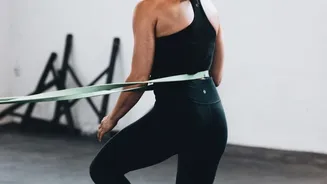







What is Rhythmic Exercise?
Before you imagine a complex, choreographed dance routine, let's simplify. Rhythmic exercise is any movement that has a steady, repetitive beat or pattern. Think about activities like jogging, skipping rope, cycling, dancing, or even drumming on a fitness
ball. The specific activity is less important than the continuous, flowing motion it involves. It’s about finding a groove and letting your body sync up with a consistent tempo, often enhanced by music. These activities are not just for cardio; they can be a powerful tool to complement and enhance your strength workouts.
The Science of a Good Groove
Why does moving to a beat feel so good? The answer lies in your brain. When you synchronize your movements with a rhythm, it can trigger the release of mood-boosting neurochemicals like dopamine and endorphins. This not only makes the activity feel more pleasurable but also acts as a natural distraction from discomfort or fatigue. Research shows that listening to music with a tempo of around 120-140 beats per minute (BPM) can reduce your perception of effort, helping you push through challenging sets. This creates a positive feedback loop: the exercise feels better, so you're more motivated to continue, leading to greater consistency and better results over time.
Warm Up With Rhythm
One of the easiest and most effective ways to integrate rhythmic exercise is during your warm-up. Instead of a few half-hearted stretches, dedicate 10 to 15 minutes to a dynamic, rhythmic activity. This could be dancing to a few of your favourite upbeat songs, doing some light shadowboxing, or using a skipping rope. This type of warm-up does more than just raise your body temperature. It primes your nervous system, improves coordination, and enhances the mind-muscle connection, preparing your body for the focused, powerful movements of strength training. You’ll walk over to the weight rack feeling energized and mentally focused.
Rhythm as Active Recovery
The time between your heavy lifting sets doesn’t have to be spent just sitting on a bench scrolling through your phone. Using this time for light, rhythmic movement is a strategy known as active recovery. After a set of squats or bench presses, instead of coming to a complete stop, try a low-impact rhythmic movement. This could be as simple as stepping side-to-side, doing light jumping jacks, or even just walking to a steady beat. This keeps your heart rate elevated, improves blood flow to your muscles, and helps clear out metabolic byproducts. It keeps the energy of the workout high and prevents the mental lull that can happen during long rest periods.
Putting It All Together
So, what does a rhythm-infused strength session look like? It's flexible, but here’s a simple template to get you started: 1. Rhythmic Warm-Up (10-15 minutes): Choose an activity you enjoy, like dancing, jogging in place, or skipping. Put on a playlist that gets you moving. 2. Strength Block 1 (e.g., Upper Body): Perform your main lifts as planned. Between each set, perform 60-90 seconds of light active recovery, like walking or arm circles to a beat. 3. Strength Block 2 (e.g., Lower Body): Perform your next series of lifts. Between these sets, you might try a different active recovery movement, like bodyweight calf raises or hip circles, keeping the motion fluid and steady. 4. Cool-Down (5-10 minutes): Transition to slower, more calming music. Use this time for static stretching, focusing on deep, rhythmic breathing to help your body and mind wind down.