







The Solar System's Volcanic Inferno
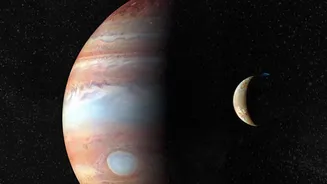
Imagine a world constantly wracked by volcanic eruptions, with fountains of lava spewing hundreds of kilometres into space. That world is Io. It is caught in a relentless gravitational tug-of-war between the colossal mass of Jupiter and the rhythmic pulls
of its neighbouring moons, Europa and Ganymede. This constant stretching and squeezing, a process called tidal heating, generates tremendous internal heat, making Io a geological inferno. For years, our understanding of this process came from infrared instruments that could only measure the temperature of the very top layer of its surface. These observations gave us stunning maps of surface lava flows but left the engine powering them largely a mystery. We could see the smoke, but not the fire below.
A New Set of Eyes: The Microwave Radiometer
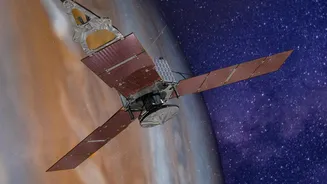
Enter NASA's Juno spacecraft and its Microwave Radiometer (MWR). This instrument was originally designed to probe the deep, dense atmosphere of Jupiter, peering through its thick cloud tops. Scientists, however, turned this powerful tool towards Io during two close flybys in late 2023 and early 2024. Unlike infrared, which only sees surface "skin" temperature, microwaves can penetrate solid material. The team was stunned to find they could see several feet, and in some cases tens of feet, into Io's rocky crust. This unexpected capability provided the first-ever direct measurements of temperature from beneath the surface of this volatile moon, opening a new chapter in planetary science.
What Lies Beneath the Crust
The MWR data returned a staggering discovery: it's incredibly hot just below the surface. Scientists found that temperatures rose by more than 22 degrees Celsius (40 degrees Fahrenheit) just a few feet down. This temperature gradient is far too steep to be explained by sunlight alone and points to significant internal heat leaking out. The data suggests two main possibilities. The first is that heat is steadily rising through a conductive crust across the entire moon. The second, more localized explanation, is that the instrument is detecting the heat from vast, cooling lava flows that are buried just beneath a thin, solid cap of rock. These findings fundamentally change our picture of Io, suggesting a world where immense heat is not just erupting from volcanoes, but constantly radiating from just below your feet.
A Surprisingly Smooth and Porous World
Beyond the heat, the microwave data also revealed another surprise about Io's physical makeup. While known for its towering mountains, the MWR data indicates that large portions of Io's surface are remarkably smooth, with plains stretching for 100 kilometres or more. The signal also suggested that the upper layers of the crust have a very low density, more akin to porous volcanic ash or pumice than solid rock. This implies that Io is continually being resurfaced by a blanket of light, fluffy eruptive debris that buries older terrain. It paints a picture of a world that is not just volcanically active, but is constantly being remade and covered by its own geologic activity, creating a landscape that is simultaneously rugged and smooth.
Implications for Earth and Beyond
The ability to see beneath the surface of a rocky, volcanic world has profound implications. Scott Bolton, Juno's principal investigator, noted that this discovery could help us study volcanoes here on Earth. A similar microwave instrument could potentially detect subsurface temperature changes that signal an impending eruption, providing new tools for hazard monitoring. Furthermore, the technique has already been used to probe the icy shells of Jupiter's other moons, Europa and Ganymede, where vast subsurface oceans are thought to exist. Understanding how heat moves through these icy crusts is a key piece of the puzzle in determining whether those hidden oceans could harbour environments suitable for life. What started as a look at Jupiter is now reshaping how we explore the entire solar system.