




The Legend of a Foolish Bird
For centuries, the dodo has been a symbol of stupidity. Discovered on the island of Mauritius in the late 1500s, it was extinct less than 70 years later. The story passed down was one of a fat, flightless bird so dim-witted that it would walk right up to the sailors
who hunted it. Its scientific name, Raphus cucullatus, was even preceded by one proposed by Carl Linnaeus: Didus ineptus, literally the 'inept dodo'. This reputation, cemented by tales and cultural portrayals like in 'Alice's Adventures in Wonderland', painted a picture of a creature doomed by its own foolishness. But this narrative unfairly places the blame on the victim of rapid human expansion and the introduction of invasive species to its once-safe island home.
A Rare Look Inside the Skull
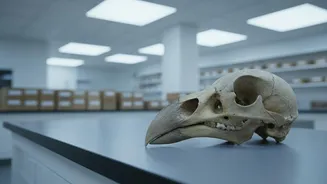
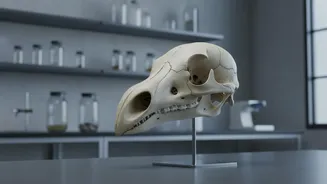
To get a truer picture, scientists turned to the world's rarest dodo artifacts: the only two complete skulls known to exist, one housed in Denmark and the other at Oxford University. Using high-resolution computed tomography (CT) scanners, an international team of researchers created detailed 3D digital models of the skulls' interiors. This non-damaging technique allowed them to reconstruct what the dodo's brain looked like, as the brain leaves an imprint on the inside of the skull during development. By creating these 'endocasts', they could analyse the size and shape of different brain regions and compare them to the dodo's closest living relatives, pigeons and doves. This provided the first real, evidence-based look at the dodo's neural hardware.
A Brain Built for More Than Bumbling
The scans delivered a major surprise. The dodo's overall brain size was found to be completely average for a bird of its size. There was no evidence to suggest it was less intelligent than its modern relatives, like the common pigeon—a bird known to be quite smart. Scientists found that the part of the brain associated with cognition and memory was not unusually small, directly challenging the notion that the dodo was inherently unintelligent. Its apparent fearlessness towards humans was likely a result of evolving for millennia on an island with no natural predators. It wasn't stupidity; it was a misplaced trust in a threat it had never learned to fear.
An Unexpected Sensory World
The research didn't just debunk the 'dumb' myth; it revealed a unique set of sensory adaptations. The scans showed that the dodo had significantly enlarged olfactory bulbs, the brain region responsible for the sense of smell. This suggests the dodo had a much keener sense of smell than its pigeon relatives, likely to help it find ripe fruit and other food in its forest environment. Furthermore, the optic lobes, which process visual information, were surprisingly small. This trait is often seen in nocturnal or crepuscular (active at dawn and dusk) birds like owls and kiwis. Researchers speculate the dodo may have been active during these low-light hours, perhaps to avoid competition for food with the island's large tortoise population. An enlarged trigeminal nerve also suggests its beak was highly sensitive to touch, helping it feel its way around.
A New Portrait of an Extinct Icon
Taken together, these findings paint a new picture of the dodo. Far from a clumsy failure, it appears to have been a highly specialised bird, well-adapted to its unique island ecosystem. It navigated its world not primarily by sight, like a pigeon, but through a powerful sense of smell and touch, possibly under the cover of twilight. Its brain was perfectly adequate for its needs, and its extinction was not a failing of its own biology but a consequence of a sudden, human-caused environmental catastrophe. The dodo wasn't too foolish to survive; it was simply unprepared for the sudden arrival of hunters and the invasive species that came with them.