




What is a Solar Hibernation?
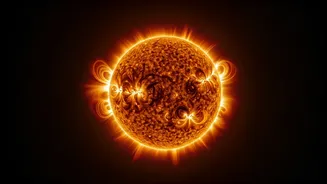
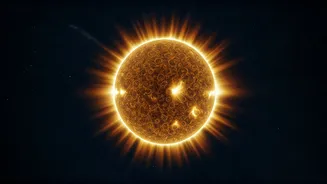
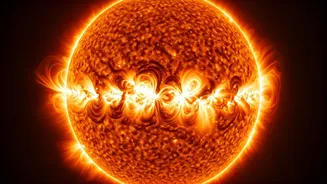
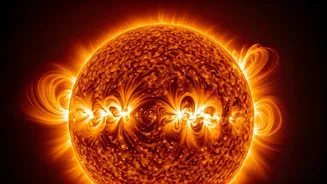
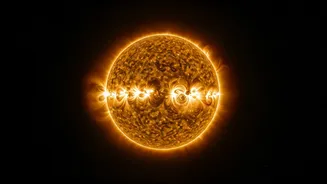
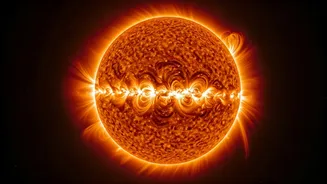
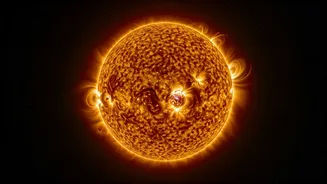
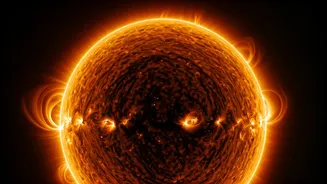
A 'solar hibernation' is a more dramatic term for what scientists call a 'grand solar minimum'. This is a prolonged period, lasting several decades or even a century, where the sun's activity drops dramatically. Normally, the sun operates on a roughly
11-year cycle, moving from a solar minimum (fewer sunspots and solar flares) to a solar maximum (more sunspots and flares). A grand solar minimum is like an extended, deeper version of the regular minimum. During these episodes, the sun's magnetic field weakens, sunspot sightings become rare, and less ultraviolet radiation is emitted. This is not just a theoretical concept; we have observed these events in the past.
A Look Back in Time
The most famous example of a grand solar minimum is the 'Maunder Minimum', which occurred between 1645 and 1715. During this 70-year span, astronomers observed an almost complete absence of sunspots. This period coincided with the middle part of the 'Little Ice Age', a time of cooler temperatures in parts of the world, especially the Northern Hemisphere. While it's tempting to draw a direct line between the two, scientists are cautious. The Little Ice Age began before the Maunder Minimum and was likely caused by multiple factors, including significant volcanic activity which can block sunlight. However, the correlation is strong enough to suggest that a prolonged dip in solar output could have a noticeable cooling effect on our planet.
The Challenge of Prediction
The headline-making finding is not that these hibernations can happen, but that forecasting them is incredibly difficult. Despite centuries of observation and modern computer models, predicting the sun's behaviour is a formidable challenge. Scientists have struggled to accurately forecast the strength and timing of even the regular 11-year cycles. For instance, predictions for the current Solar Cycle 25 were largely for a weak cycle, but it has proven to be more active than anticipated. The models used to predict these cycles are not yet as robust as those used for weather forecasting on Earth. This unpredictability extends to grand solar minima, making it hard to know if or when the next deep slumber might begin.
Potential Impacts on Earth
If a grand solar minimum were to occur, what would it mean for us? The most discussed impact is on climate. Studies suggest a Maunder Minimum-like event could cool the planet, but only by a small amount—perhaps up to 0.3 degrees Celsius. This would not be enough to stop or reverse human-caused global warming but might temporarily slow it. NASA has stated that the warming from greenhouse gases is significantly greater than the potential cooling from a solar minimum. Other effects could be more pronounced. A weaker solar magnetic field allows more galactic cosmic rays to enter our solar system and atmosphere, which could have effects on cloud formation and atmospheric chemistry. It could also impact our technology, as changes in solar activity affect satellite orbits and communications systems.
Why We Can't See It Coming
The sun's activity is driven by a complex internal engine, a 'dynamo' of moving plasma that generates its magnetic field. We cannot observe this dynamo directly, so scientists rely on surface features like sunspots and the sun's polar magnetic fields to infer what is happening inside. The physical models are complex, and many variables are at play. Some recent studies using new models have tried to predict the next few decades, with some researchers suggesting a grand minimum could start soon, while others remain unconvinced. The fact is, our observational record is relatively short in the grand scheme of the sun's lifespan, and there may be long-term patterns or elements of randomness that our current science cannot yet fully grasp.