

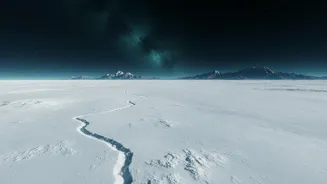


Pluto's Beating Heart of Ice
The most iconic feature revealed by New Horizons is Tombaugh Regio, a bright, heart-shaped region on Pluto's surface. The western lobe of this heart, a vast basin named Sputnik Planitia, is not made of water ice but is a massive glacier of frozen nitrogen,
larger than Texas and Oklahoma combined. Scientists were astonished to find that this plain is almost completely devoid of impact craters, suggesting its surface is incredibly young, perhaps less than a million years old. The surface is broken into city-sized polygonal cells that look like mud cracks, evidence that the solid nitrogen ice is slowly churning, or convecting, like a thick pot of oatmeal. This slow overturning constantly renews the surface, erasing craters and revealing a world far more active than expected.
Flows of Solid and Gas
At Pluto’s frigid surface temperatures of around minus 230 degrees Celsius, nitrogen ice can flow like a glacier on Earth. This solid-state movement explains the massive, churning cells. But Pluto's nitrogen is also involved in a weather cycle. Faint sunlight causes some of the surface ice to sublimate, turning directly into nitrogen gas. This gas forms a thin atmosphere which then refreezes onto the surface at night or in colder regions. This cycle is believed to drive winds that are powerful enough to create dunes and streaks on the surface, further shaping Pluto's dynamic landscape.
The Search for Liquid
While flowing solid ice is a major discovery, the question of liquid nitrogen is even more tantalizing. A recent analysis, published in The Planetary Science Journal, points to new evidence suggesting liquid nitrogen has recently flowed on Pluto. Researchers examining images of northern Sputnik Planitia noticed dark linear and diffuse features along the boundaries of the convection cells. These patterns strongly resemble features on Earth's glaciers that have been wetted by rain or by liquid emerging from below the surface.
An Underground Source
Since Pluto's thin atmosphere and extreme cold make nitrogen rain physically impossible, the liquid must be coming from below. The leading hypothesis is a process called basal melting. Scientists believe that heat from Pluto’s interior—perhaps from the slow decay of radioactive elements in its core—could be just enough to melt the very bottom of the thick nitrogen ice sheet. This liquid nitrogen, under pressure, could then be forced up through cracks and fractures in the glacier, briefly flowing across the surface before freezing again. Computer simulations confirmed it was feasible for liquid nitrogen to push upward from beneath the glacier, creating the dark, 'wetted' patterns seen by New Horizons.
A New Kind of Activity
This evidence represents a new kind of time-variable feature on Pluto, suggesting the dwarf planet is geologically active in ways previously unimagined. Alan Stern, the principal investigator for the New Horizons mission, noted that "Pluto never stops surprising us." The finding implies that Pluto retains more internal heat than models had predicted for a body so small and so far from the sun. The discovery challenges our fundamental understanding of what it takes for a world to be active. It suggests that even in the coldest, darkest reaches of our solar system, complex geological processes can still unfold.