






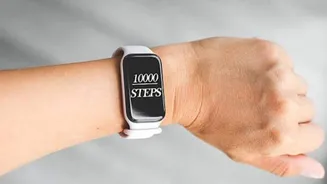
The Accidental Benchmark
First, a bit of history. The 10,000-steps-a-day goal wasn't born from a rigorous scientific study or a global health organization. It originated in Japan in the 1960s as a marketing slogan. A company, hoping to capitalize on the fitness buzz around the 1964
Tokyo Olympics, released a pedometer called Manpo-kei, which translates to “10,000 steps meter.” The name was catchy, the number was round and aspirational, and an international fitness myth was born. It was a brilliant marketing move that embedded itself into our collective consciousness, eventually becoming the default setting on countless digital trackers worldwide. But it was never a medical prescription.
What The Science Actually Says
In recent years, researchers have finally put the 10,000-step rule to the test, and the results are both surprising and liberating. Multiple large-scale studies have found that significant health benefits kick in far below the 10,000-step mark. A 2019 study led by Dr. I-Min Lee found that among older women, mortality rates decreased significantly with as few as 4,400 steps per day, with benefits leveling off around 7,500 steps. More recent meta-analyses have reinforced this, showing that every extra 1,000 steps a day is associated with a 15% reduction in the risk of dying early. The most significant gains are seen when moving from a sedentary lifestyle to even moderate activity. For reducing cardiovascular disease risk, benefits begin to show with as few as 2,337 steps per day. While walking more is generally better, the health benefits tend to plateau. For those under 60, this happens around 8,000 to 10,000 steps, and for those over 60, it's between 6,000 and 8,000 steps.
The Power of Simply Showing Up
This brings us to the core of the issue: consistency. The real enemy of health isn't failing to hit 10,000 steps; it's the all-or-nothing mindset that leads to giving up entirely. It is far better for your body and mind to walk for 20-30 minutes every day (which might be 3,000-4,000 steps) than to push for an exhausting 10,000 steps once a week and be sedentary the other six days. Consistency builds the habit and makes it a durable part of your lifestyle. Regular, moderate activity helps regulate blood sugar, lowers blood pressure, improves sleep, and boosts mood. When you make movement a non-negotiable part of your daily routine, like brushing your teeth, you reap cumulative rewards that sporadic, high-intensity efforts can't match. An achievable goal that you stick with will always beat an ambitious one that you abandon.
Finding Your Personal Sweet Spot
Instead of obsessing over a single number, focus on a more holistic and personal approach. Consider aiming for the World Health Organization's recommendation of 150 minutes of moderate-intensity activity per week. This breaks down to just over 21 minutes a day. It could be a brisk 30-minute walk five days a week. Pay attention to how you feel. The goal is to get your heart rate up slightly, where you can still hold a conversation but might be a little breathless. You can also think in terms of “active minutes” rather than steps. The key is to find a target that feels challenging but sustainable for you. If you are currently getting 3,000 steps a day, aiming for 4,000 is a fantastic and meaningful goal. Small, incremental increases are the secret to long-term success.
Beyond The Step Count
Finally, remember that walking is just one piece of the fitness puzzle. A healthy, active lifestyle includes other forms of movement that pedometers don't always capture well. Strength training, for example, is crucial for building and maintaining muscle mass and bone density, which is vital as we age. Activities like swimming, cycling, yoga, or even vigorous gardening contribute significantly to your overall health, even if they don't add many steps to your daily tally. The ultimate goal isn't to win a competition with your fitness tracker; it's to build a strong, resilient body. Don't let a narrow focus on one metric discourage you from engaging in a wide variety of activities that you enjoy and that serve your health in different ways.