





An Accidental Discovery
Imagine studying a family portrait you’ve seen a thousand times, only to notice a previously unseen person hiding in the background. That's essentially what happened to a team of astronomers using the James Webb Space Telescope (JWST). They were focused
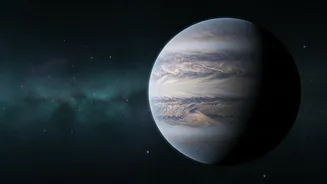
on Beta Pictoris, a young star just 63 light-years away, and were analysing the atmosphere of a known giant planet, Beta Pictoris b. Instead, a mysterious and unexpected signal appeared in their data, a tell-tale sign that something else was there. This wasn’t a faint dot of light, but a distinct chemical pattern. After careful analysis, the team confirmed the unthinkable: they had accidentally discovered a third planet in the system, now named Beta Pictoris d. What makes this discovery so remarkable is that astronomers had been observing this system for decades, but the planet remained completely hidden until now.
Hiding in the Glare
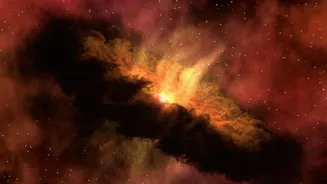
So, how did a planet at least twice the mass of Jupiter manage to evade detection for so long in one of the most studied planetary systems in the sky? The answer lies in its environment. The Beta Pictoris system is surrounded by an enormous, bright disk of dust and debris left over from its formation. This disk scatters starlight so intensely that it creates a kind of cosmic fog, washing out the faint light of any planets orbiting within it. Traditional methods of finding exoplanets often rely on direct imaging—essentially taking a photograph and looking for a point of light. In this case, the glare from the debris disk made that impossible, concealing Beta Pictoris d from view. It was a perfect hiding spot, requiring a completely different approach to uncover the world within.
The Chemical Barcode
This is where the power of JWST’s Near-Infrared Spectrograph, or NIRSpec, came into play. Instead of just trying to see the planet, NIRSpec analyses light by breaking it down into its component wavelengths, creating a spectrum. This spectrum acts like a chemical barcode. Every element and molecule absorbs light at specific wavelengths, leaving a unique pattern of dark lines. While studying the data, astronomers expected to see a smooth spectrum from the light reflecting off the dust. Instead, they found a distinct, barcode-like pattern of absorption lines indicating the presence of carbon monoxide. This chemical fingerprint is a hallmark of a giant planet’s atmosphere. Follow-up analysis also located signals for water vapor and methane. It wasn't the planet's light they found, but the chemical signature of its atmosphere, allowing them to 'see' it through the dust.
A New Way to Find Worlds
The discovery of Beta Pictoris d is more than just adding another planet to our catalogue. It represents a paradigm shift in how we can find exoplanets. It’s the first time a planet has been found primarily through this spectroscopic method, proving that astronomers can identify worlds not just by their brightness but by their atmospheric chemistry. This technique could be revolutionary for finding planets in other complex environments, such as the crowded centers of star clusters or inside other bright, dusty disks. The presence of Beta Pictoris d might also solve some long-standing mysteries about its home system, potentially explaining unusual structures and the sharp inner edge of the debris disk. Scientists are now continuing to analyse the data to learn more about the new planet's temperature, size, and orbit.