





1. Raj Bhavan: The Seat of Power
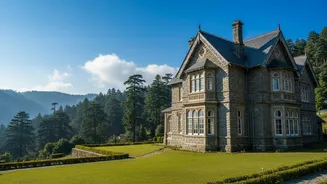
Modelled on Buckingham Palace, the Raj Bhavan, formerly Government House, is the grandest statement of British authority in Nainital. Its construction began in 1897 and it served as the summer residence of the governor of the United Provinces. Designed
in a magnificent Victorian Gothic style, this sprawling estate with its turrets, stone facade, and 113 rooms was built to project power and prestige. It established Nainital not just as a getaway but as the epicentre of regional governance, a character it retains today as the official residence for the Governor of Uttarakhand. The building’s sheer scale and European castle-like appearance cemented Nainital's status as a key administrative hub.
2. Uttarakhand High Court: The Pillar of Law
Before it became the seat of the state's highest court in 2000, this imposing building was known as the 'Old Secretariat'. Constructed in 1900 by architect Santoni MacDonald, its striking Gothic design signalled the importance of law and bureaucracy in the colonial town. Functioning as the main administrative office, it was the engine room of the summer capital. Its presence ensured that Nainital was more than a resort; it was a place of serious work where the machinery of the state operated. Today, as the High Court of Uttarakhand, it continues this legacy, representing justice and governance at the heart of the town.
3. St. John in the Wilderness Church: A Sanctuary of Faith
Established in 1844, this was one of the very first structures built in Nainital, making it a cornerstone of the colonial settlement. Its hauntingly beautiful Neo-Gothic architecture, set amidst a dense deodar forest, speaks of the settlers' desire to create a spiritual home away from home. The church was named when the Bishop of Calcutta, Daniel Wilson, fell ill and had to stay in an unfinished hut in the forest while laying the foundation. It also serves as a solemn memorial, with brass plaques dedicated to the victims of the devastating 1880 landslide, embedding a sense of history and remembrance into the town's fabric.
4. Sherwood College: The Foundation of Education
Founded in 1869 as the Diocesan Boys School, Sherwood College helped define Nainital's enduring identity as a premier educational centre. The British established such elite boarding schools in hill stations to educate their children and those of the Indian elite in a climate that mimicked England's. Spread over a 45-acre campus on Ayarpatta Hill, the school’s Gothic-inspired structures and sprawling grounds created an exclusive world of learning. This legacy of high-quality residential education, initiated by institutions like Sherwood, continues to draw students from across the country, shaping Nainital’s academic and cultural life.
5. Gurney House: A Glimpse into Domestic Life
Away from the grand public buildings, Gurney House offers a more intimate look at colonial life. This was the residence of the famous hunter-turned-conservationist Jim Corbett and his family until 1947. Built in 1881, the charming and rustic cottage was constructed with materials from the family's previous home, which had been on a hill affected by a landslide. It represents the private, domestic sphere of the British in India—a life connected to the surrounding wilderness. Preserving Corbett's legacy, the house infuses Nainital with a spirit of conservation and a deep connection to its natural environment.
6. The Naini Retreat: The Era of Princely India
Originally the summer palace of the Maharaja of Pilibhit, this building illustrates another layer of Nainital's character: its role as a favoured retreat for Indian royalty. While the British established the town, Indian princes and maharajas soon followed, building their own grand residences to enjoy the summer season and socialise within elite circles. Now a heritage hotel, The Naini Retreat retains the grandeur of a royal residence, reflecting a time when colonial administrators and Indian aristocrats coexisted in this fashionable hill station. It speaks to a unique blend of British and Indian aristocratic cultures.
7. Nainital Yacht Club: The Hub of Leisure
Founded in 1910 and housed in the Boat House Club, the Nainital Yacht Club is a testament to the town's identity as a centre for recreation and elite leisure. Located at over 2,000 metres, it is one of the highest yacht clubs in the world. The British established it to pursue sailing, a quintessential pastime, on the Naini Lake. This introduced a culture of exclusive social clubs and organised sport that defined the lifestyle of the colonial elite. Even today, the sight of yachts on the lake is an iconic part of the Nainital experience, a direct legacy of this colonial pursuit of leisure.