



Two Lumps of Rock
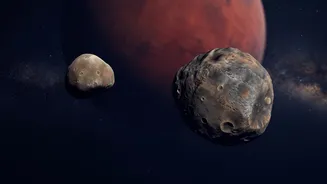
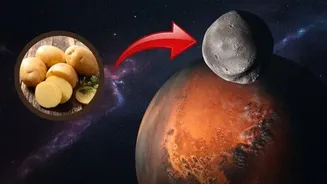
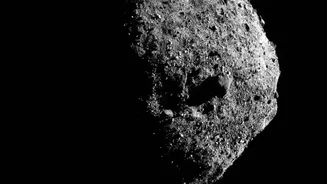
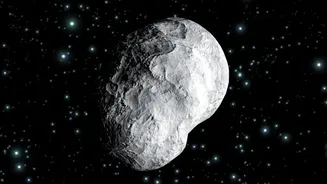
Unlike Earth’s spherical Moon, Phobos and Deimos are distinctly non-spherical. Phobos, the larger of the two, measures about 27 by 22 by 18 kilometers, while Deimos is a mere 15 by 12 by 11 kilometers. Their small size means they lack the gravitational
pull necessary to form a round shape, leaving them as irregularly shaped bodies. These lumpy forms are a key clue in the mystery of their formation. They look like asteroids, and for a long time, that was the leading theory of their origin.
The Captured Asteroid Theory
The first major theory suggests that Phobos and Deimos are asteroids that strayed too close to Mars and were captured by its gravity. This would explain their appearance; their dark, cratered surfaces and low densities are very similar to primitive, carbon-rich asteroids found in the outer solar system. However, there is a significant problem with this theory. When a planet captures an asteroid, the new moon typically has a strange, elliptical orbit. Phobos and Deimos, however, have nearly perfect circular orbits that lie almost exactly on Mars's equatorial plane. This type of orbit is unlikely for a captured object, leading many scientists to question this hypothesis.
The Giant Impact Hypothesis
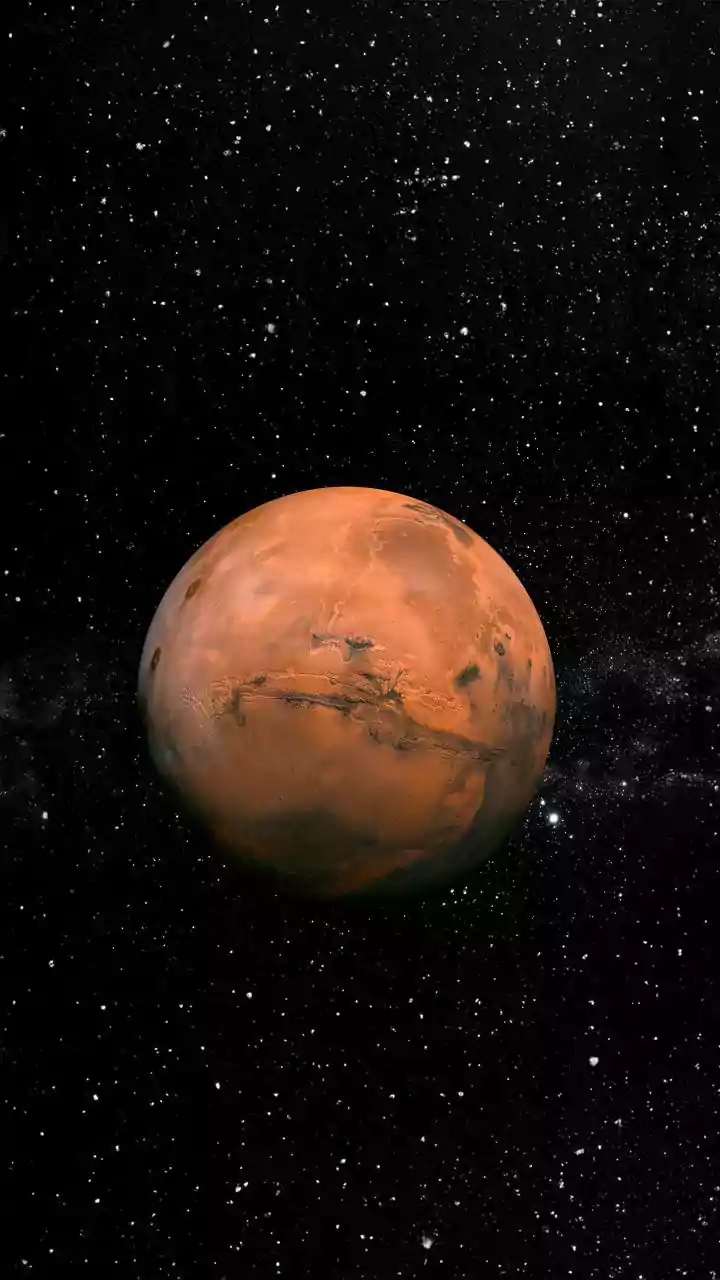
A more recent and increasingly popular theory proposes that the moons were born from Mars itself. Much like how Earth's Moon is thought to have formed from debris after a massive collision, this hypothesis suggests a large object, perhaps a planetesimal, slammed into a young Mars billions of years ago. This impact would have blasted a massive amount of Martian rock and debris into orbit, which then would have clumped together over time to form Phobos and Deimos. This scenario neatly explains their tidy, circular, and equatorial orbits. Analysis of old data from the Mars Global Surveyor has provided evidence supporting this idea, suggesting that Phobos's composition may be more similar to the Martian crust than it first appears.
What New Research Suggests
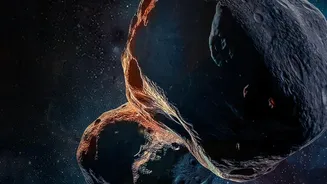
Recent research continues to refine our understanding. A study in August 2026, using data from the European Space Agency's Hera mission, explained the surprisingly smooth surface of Deimos. It suggests a single, large impact created its most prominent crater and blanketed the moon in a layer of fine dust, or regolith, hiding older craters. This shows that even after their initial formation, the moons have had a violent history. Another new model proposes a hybrid idea: that a passing asteroid was ripped apart by Mars's gravity, forming a debris ring from which the moons then coalesced. This could potentially reconcile aspects of both the capture and impact theories.
Answering the Question Once and for All
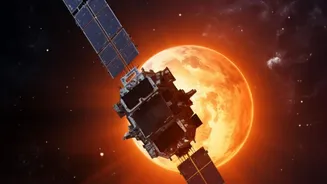
The scientific community may soon have a definitive answer. The Japan Aerospace Exploration Agency (JAXA) successfully launched its Martian Moons eXploration (MMX) mission on October 20, 2026. The spacecraft is scheduled to arrive at Mars in August 2027, where it will land on Phobos, collect at least 10 grams of surface material, and return it to Earth. This will be the first sample ever returned from the Martian system. By analyzing these samples in labs on Earth, scientists will be able to determine their exact composition. If they are rich in materials found on Mars, it will strongly support the giant impact theory. If they more closely resemble primitive asteroids, the capture hypothesis will be strengthened. The mission is expected to bring the samples back to Earth in 2031.