

A Planet's Invisible Shield
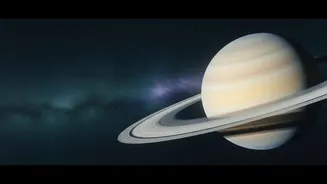
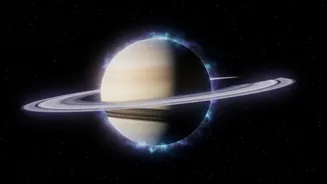
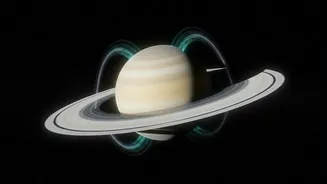
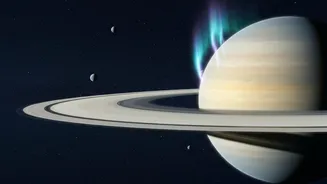
Imagine an invisible bubble surrounding a planet, shielding it from the harsh solar wind—a constant stream of charged particles flowing from the Sun. That’s a magnetosphere. Earth has one, and so does Saturn, but Saturn's is enormous, stretching more
than ten times the planet's own diameter. This magnetic field is generated deep inside the planet by the movement of metallic fluids. For years, scientists studied this shield, assuming it behaved like a bigger version of Earth's. But a ghost from Saturn's past, the Cassini spacecraft, has sent back data that is rewriting the rules.
A Postcard from a Silent Explorer
The Cassini mission, a joint effort by NASA, the European Space Agency, and the Italian Space Agency, orbited Saturn from 2004 to 2017, collecting invaluable data. Though the spacecraft itself is long gone, the treasure trove of information it gathered is still being analyzed. Recent studies have focused on a curious feature of the magnetosphere: its distortion. Scientists found that Saturn’s magnetic shield isn't the symmetrical bubble they saw around Earth; it's lopsided and warped in a peculiar way.
Reading the Asymmetry
So, how do scientists “read” this distortion? They focused on the magnetosphere's “cusps.” These are funnel-like openings near the poles where solar wind particles can leak into the planet's atmosphere. On Earth, these cusps are reliably located around the “noon” position, directly facing the Sun. By analyzing six years of Cassini data, scientists mapped the location of Saturn’s cusps and found something startling. Instead of being at noon, Saturn's cusps are consistently dragged toward the “afternoon” side, appearing between 1:00 and 3:00 on a clock face. This consistent skew is the distortion, and it tells a fascinating story.
The Two Forces Warping the Shield
This afternoon-shift is caused by two powerful internal forces that overpower the Sun's influence. The first is Saturn’s incredibly fast rotation; a day on the planet lasts just 10.7 hours. The second, and perhaps more surprising factor, is its moon Enceladus. The icy moon constantly spews massive plumes of water vapor from its subsurface ocean. This vapor becomes ionized, creating a thick, heavy “soup” of plasma that surrounds Saturn. The planet’s rapid spin drags this plasma soup along with it, effectively twisting the entire magnetic field and pulling the cusps away from the noon position.
Why This Discovery Matters
Understanding this distortion isn't just a quirky detail. It confirms a long-held theory that for giant, fast-spinning planets, their own rotation and local environment are more important than the solar wind in shaping their magnetospheres. This is fundamentally different from how Earth's shield works. This knowledge changes how scientists interpret Saturn’s vibrant auroras and where they expect explosive energy releases to occur. More importantly, it gives us a new framework for studying the thousands of gas giant exoplanets discovered far beyond our solar system, helping us understand their potential environments without ever visiting them. This new reading of Saturn's magnetosphere is crucial for planning future missions to the system, especially to the potentially life-harboring moon Enceladus.