



A New Hope for Martian Weather
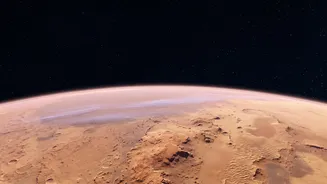
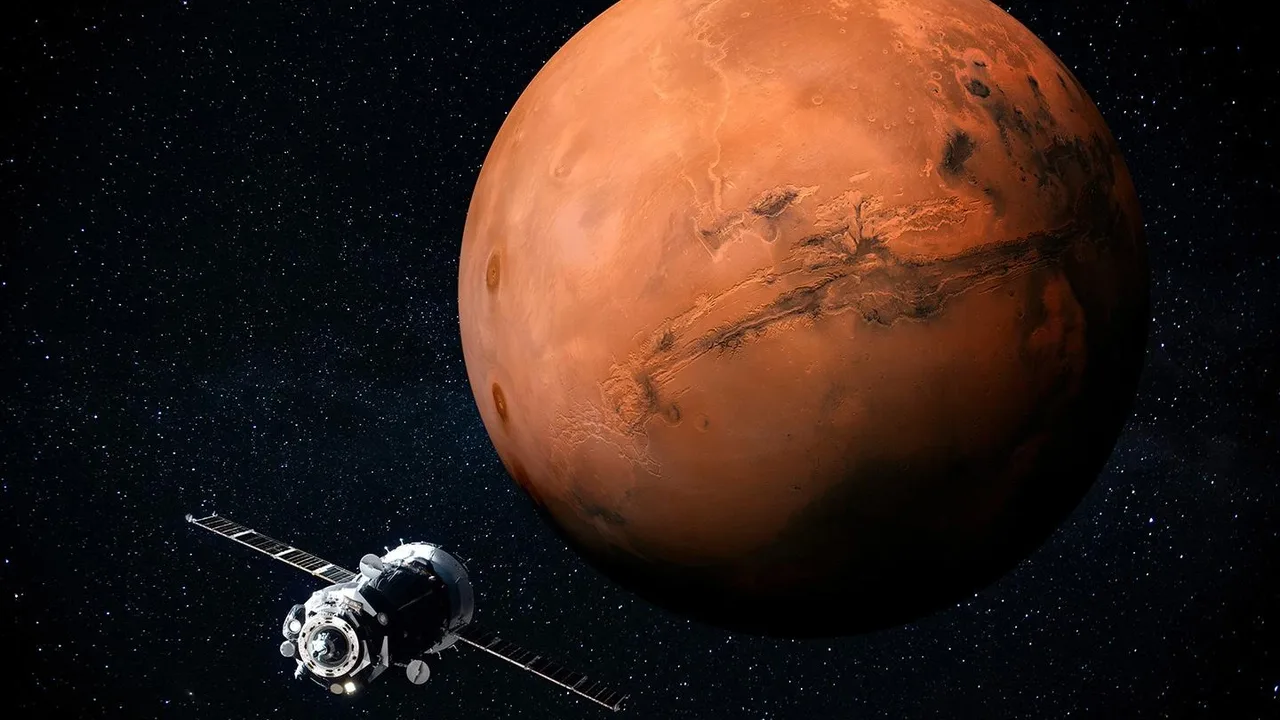
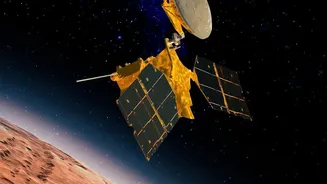
Launched in 2020, the United Arab Emirates' Hope probe, also known as Al-Amal, is the Arab world's first interplanetary mission. Its primary goal is not to land on the surface, but to perform a comprehensive study of the Martian atmosphere from a unique
elliptical orbit. This special orbit allows it to capture a complete, global picture of the planet's atmospheric dynamics, tracking changes across different times of day and through the seasons. The mission was designed to answer key questions about Mars's climate, particularly how it lost its once-thicker atmosphere and flowing water. By providing the first complete picture of the Martian atmosphere and its layers, Hope is delivering a treasure trove of data accessible to scientists all over the world.
The Old View of Martian Heat
For years, our understanding of Martian weather was based on snapshots from rovers on the ground or orbiters that passed over the same spot at the same time each day. The general model was that the thin, carbon dioxide-rich atmosphere was poor at trapping heat. Heat transfer was thought to be relatively straightforward: the sun warms the ground and the lower atmosphere during the day, and that heat radiates back into space at night. While scientists knew about Mars's massive dust storms, which can enshroud the entire planet and absorb solar radiation, the day-to-day movement of thermal energy across the globe was believed to be limited by the thin air. The planet's climate was seen as being dominated by surface radiation and the occasional chaos of a planet-encircling dust storm.
Rewriting the Climate Model
The continuous, global data from Hope is challenging these older models. The findings suggest that the Martian atmosphere is far more interconnected than previously thought. Scientists are discovering new patterns in the way heat and energy are transported, not just from the equator to the poles, but vertically between atmospheric layers and potentially between the planet's sunlit day side and its frigid night side. This points to a much more dynamic system where the lower and upper atmospheres are intimately linked. These discoveries are forcing a rethink of how the Martian climate engine works, suggesting that heat can be redistributed around the planet in ways that earlier, less complete data sets couldn't reveal. Understanding this complex heat movement is crucial for explaining everything from atmospheric escape to the formation of clouds and storms.
India's Stake in a Global Discovery
The data from the Hope mission is publicly available, creating a powerful resource for the global scientific community. For India, which made history as the first nation to reach Mars on its first attempt with the Mars Orbiter Mission (MOM), this data is invaluable. Indian scientists at institutions like the Indian Space Research Organisation (ISRO) have a deep well of experience in atmospheric and planetary science. As early as 2020, ISRO officials noted that data from Hope on aspects like dust transport would be an important input for planning India's next mission to Mars. The global coverage provided by Hope perfectly complements the high-resolution but more localized data from India's MOM and other missions. This allows Indian researchers to integrate the new findings into their own atmospheric models, contributing to the global effort to decode the Martian climate without necessarily having their own probe on site.
Why It Matters for Future Missions
A better understanding of Martian heat movement isn't just an academic exercise. It has profound practical implications for future exploration. Every spacecraft that attempts to land on Mars must navigate its temperamental atmosphere. Accurate weather models are essential for predicting atmospheric density for aerobraking manoeuvres and for ensuring the safe landing of rovers and, eventually, humans. Knowing how heat is distributed also helps scientists predict where water ice might be stable and understand the planet's past habitability. The insights gained from Hope's data will directly inform the design and planning of subsequent missions from space agencies around the world, including India's ambitious future plans for the Red Planet. This collaborative approach, where data from one nation's mission empowers the scientific community of another, is accelerating our shared journey of planetary exploration.