







The Boom in Buzzwords
The demand for technology professionals skilled in Artificial Intelligence (AI), Data Science, and Machine Learning (ML) is exploding in India. This has triggered a massive response from educational institutions. Recent data shows a significant spike
in the number of approved engineering seats for AI-related disciplines. For example, in Maharashtra alone, the intake for AI-focused courses nearly doubled in two years, jumping from around 14,000 to over 27,000 by the 2025-26 academic year. This surge reflects a clear alignment with industry demand, where roles in AI and data analytics now account for a substantial portion of fresh campus hires. Institutions are responding to a generation of students who see these fields not just as a trend, but as the foundation for a future-proof career.
Old Wine in a New Bottle?
This rapid expansion has raised concerns among academics and industry experts about the quality and substance behind the new course titles. The fear is that some institutions might be engaging in 'academic rebranding' — essentially, renaming existing Computer Science or Information Technology courses to attract students, without making the necessary fundamental changes to the curriculum. An outdated syllabus that doesn't reflect current industry needs is a long-standing issue in Indian technical education. While a course may be labelled 'AI & Data Science', its core structure might still be heavily based on traditional, theoretical computer science modules that are not adequately preparing students for the specialised skills required in the modern job market.
The Critical Infrastructure Gap
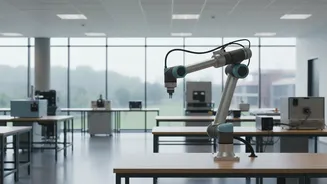
Perhaps the most significant challenge is the gap between a course's title and the physical facilities available to students. True expertise in fields like robotics, IoT, or advanced AI cannot be developed through theory alone. It requires state-of-the-art laboratories, high-performance computing clusters for processing large datasets, and access to modern software and hardware. These facilities are expensive to build, maintain, and upgrade. There is a stark difference between the ease of changing a course name in a prospectus and the significant investment required to build a functional robotics lab or a data science centre with the necessary computational power. Without this hands-on experience, students are left with theoretical knowledge that is difficult to apply, leaving them ill-prepared for industry demands.
Faculty Readiness and Regulatory Oversight
Another crucial piece of the puzzle is the faculty. Teaching emerging technologies requires educators who are themselves continuously learning and are in touch with the latest industry practices. Recognizing this, the All India Council for Technical Education (AICTE) has launched certificate programs to upskill faculty in domains like AI, ML, and Drone Technology. However, a gap often remains, with many instructors teaching what they learned years ago, using curricula that haven't kept pace. While regulatory bodies like AICTE have an approval process, the sheer volume of new course applications makes it challenging to conduct in-depth, on-the-ground verification of labs and faculty expertise for every single institution.
How Students Can Look Beyond the Label
For prospective students and their families, navigating this landscape requires diligence. It is crucial to move beyond the marketing and the allure of a trendy course title. Aspiring engineers should scrutinize the detailed curriculum. Ask specific questions during admissions: What are the qualifications and recent industry exposure of the faculty teaching these specialised subjects? Enquire about the laboratory facilities. Are there dedicated labs for AI, robotics, or IoT? Ask for a tour, even a virtual one, and look for modern equipment. Checking for accreditations from bodies like the National Board of Accreditation (NBA) can also be an indicator of quality. Ultimately, speaking to current students and recent alumni can provide the most honest assessment of whether the reality of the programme lives up to its promise.