






The Five-Year Prediction
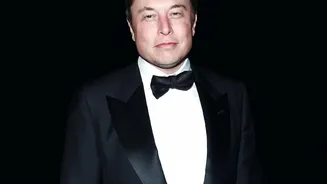
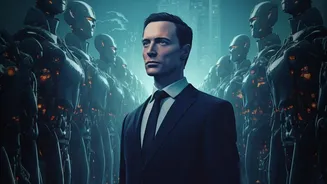
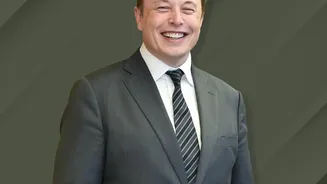
In a recent interview, Elon Musk stated that AI's intelligence will likely eclipse the sum total of human intellect in about five years. He elaborated on this by suggesting that a decade from now, it is unlikely humans will still be the dominant intelligence on the planet.
Musk has often spoken about the risks and rewards of AI, but this new, accelerated timeline has reignited debate across the tech industry. His forecast isn't just about computers getting smarter; he envisions a future of “incredible abundance” where AI and robotics can produce nearly any good or service on demand. This, he suggests, would fundamentally reshape our economy, potentially making concepts like money and inflation obsolete.
What Is Superintelligence?
To understand Musk's forecast, it’s crucial to distinguish between the AI we use today and what he’s describing. Currently, we interact with 'narrow AI'—systems designed for specific tasks, like language translation or playing chess. The next theoretical step is Artificial General Intelligence (AGI), an AI that can learn and problem-solve as flexibly as a human. What Musk is referring to, however, is Artificial Superintelligence (ASI). ASI is a hypothetical form of AI that would not just match, but vastly surpass human intelligence in virtually every field, from scientific creativity to emotional understanding. It represents a point where a machine could self-improve at a rate incomprehensible to humans, a concept known as the 'singularity'.
A History of Bold Forecasts
This isn't the first time Musk has made a bold prediction. His career is built on ambitious timelines for SpaceX, Tesla, and his other ventures. For example, he predicted that a majority of new cars sold would be electric by 2031, a trend that is already well underway in some countries. However, he has also been famously optimistic on other fronts. His predictions for fully autonomous, self-driving cars have been pushed back multiple times, a point he has acknowledged himself. Likewise, his timelines for human missions to Mars have also been revised. This history of both hits and misses makes his five-year ASI timeline a subject of intense speculation. Sceptics point to his track record as a reason for caution, while supporters argue the rapid acceleration in AI capabilities in recent years justifies the aggressive forecast.
Exhilaration and Terror
Musk himself seems to hold two conflicting views on this future, describing his feelings as a mix of “exhilaration and terror.” For years, he warned that developing advanced AI was like “summoning the demon” and posed a greater risk than nuclear weapons. He has consistently put the odds of an AI-driven catastrophe at somewhere between 10% and 20%. Despite this, his more recent stance, articulated in a July 2026 interview, is one of cautious optimism. He argued that the momentum behind AI is now unstoppable and that the most likely outcome is a world of abundance, making the risk worth taking. To manage the danger, he has proposed an industry-led peer-review system, where top AI labs like OpenAI, DeepMind, and his own xAI would check each other's work for safety before public release.
What Do Other Experts Think?
The expert community remains deeply divided on AI timelines. While some prominent figures in the industry share Musk's sense of imminence, many others are more conservative. Broader surveys of AI researchers have often placed the arrival of AGI decades away, with a median forecast closer to 2047. A key part of the disagreement stems from the lack of a shared definition for AGI or ASI. Different leaders are essentially predicting different things. While Musk sees a machine smarter than any human, others define the goal as automating complex jobs or achieving novel scientific breakthroughs. This ambiguity makes it difficult to have a cohesive debate. However, what most experts do agree on is that the pace of AI progress is accelerating much faster than previously anticipated, making conversations about its impact more urgent than ever.