





A World Full of Surprises
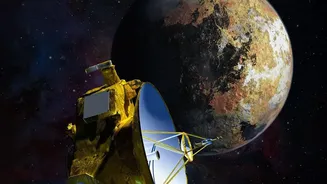
When NASA's New Horizons spacecraft flew past Pluto in 2015, it sent back images that stunned scientists. Instead of a cold, dead world, the pictures revealed a surprisingly complex and dynamic landscape. There were towering mountains made of water ice,
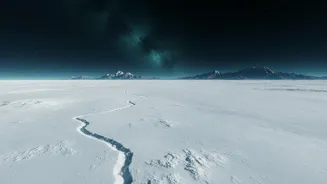
which is as hard as rock at Pluto's frigid temperatures of around -230°C. Most strikingly, there was a vast, heart-shaped basin of nitrogen ice, named Sputnik Planitia, that was almost completely free of impact craters. A lack of craters suggests a geologically young surface, meaning something has been actively reshaping it, wiping the slate clean over time. This was the first major clue that Pluto was far from inactive.
The Clues in the Ice
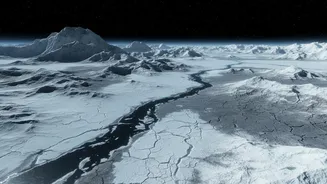
The latest research, published in early August 2026, zooms in on Sputnik Planitia. Scientists noticed dark streaks along the boundaries of large, city-sized cells of churning nitrogen ice. Their analysis suggests that these features are signs of liquid nitrogen occasionally welling up from beneath the glacier and flowing onto the surface before refreezing. This would be the first evidence of recently flowing liquid on the dwarf planet. Since Pluto's thin atmosphere makes nitrogen rain impossible, the liquid must be coming from below. This adds to a growing body of evidence for cryovolcanism—or ice volcanoes. Features like the massive Wright Mons, a 150-kilometer-wide mountain with a deep central depression, are believed to be giant ice volcanoes, formed by eruptions of an icy, slushy mixture of water, ammonia, and other compounds. The near-total absence of craters on these formations indicates they were active in the relatively recent past.
An Unexpectedly Warm Engine
So what could be powering all this activity nearly six billion kilometres from the Sun? The answer seems to be internal heat. While small, icy worlds were expected to have lost their primordial heat long ago, Pluto appears to be an exception. Scientists theorise that Pluto has a rocky core that still generates heat through the radioactive decay of elements within it. This heat may be just enough to maintain a vast ocean of liquid water, perhaps mixed with ammonia which acts as an antifreeze, deep beneath its icy shell. This subsurface ocean would insulate the core, helping it stay warm. Heat from the interior could melt nitrogen ice at the base of glaciers like Sputnik Planitia, causing it to well up through cracks and fissures in the surface.
Rewriting the Rules of the Solar System
The discovery of ongoing activity on Pluto forces us to rethink the conditions required for a world to be dynamic. It was once assumed that only large, rocky planets or moons heated by the strong gravity of a nearby giant planet could have active geology. Pluto fits neither of those descriptions. Its existence as an active world suggests that many other objects in the Kuiper Belt—the distant region of icy bodies beyond Neptune—could also be surprisingly complex. Recent analysis has also confirmed the first-ever landslides on Pluto, another sign of an evolving surface. These findings reinforce the view that Pluto is not a planetary relic but a living world, geologically speaking, that continues to evolve and change. It serves as a powerful reminder of how much we still have to learn about the mysterious outer reaches of our own solar system.