

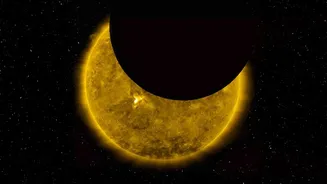
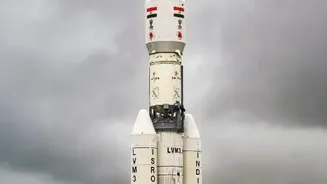
The Sun, our vital star, is also a source of violent eruptions. Now, ISRO's Aditya-L1 mission is providing a clearer picture than ever, revealing new insights into a powerful solar storm from over two years ago.
India’s Unblinking Eye on the Sun
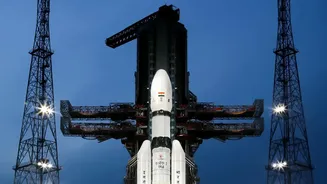
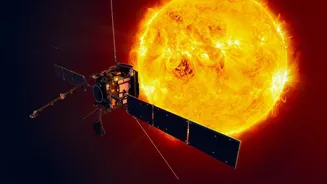
Launched by ISRO in September 2023, Aditya-L1
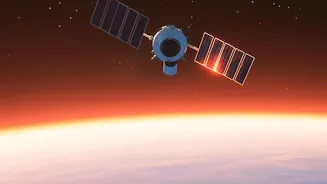
is India’s first dedicated solar mission. It operates from a unique vantage point in space, a halo orbit around the Sun-Earth Lagrange Point 1 (L1), approximately 1.5 million kilometres from Earth. This special location allows the observatory to watch the Sun continuously, without being blocked by the Earth or Moon. Its suite of seven advanced instruments is designed to observe the Sun’s atmosphere—the photosphere, chromosphere, and the outermost corona—in multiple wavelengths, providing a comprehensive view of solar activities. Four payloads conduct remote sensing of the Sun, while three perform in-situ measurements of particles and magnetic fields, giving scientists a complete picture of solar events.
Recalling the Eruption of August 2024
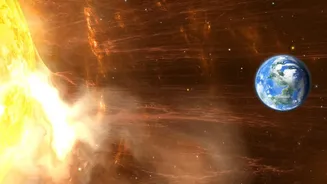
On August 5, 2024, the Sun unleashed a powerful eruption known as a Coronal Mass Ejection (CME). CMEs are colossal explosions of plasma and magnetic fields from the Sun's corona that can travel through space at incredible speeds. The year 2024 was marked by heightened solar activity as part of Solar Cycle 25. This particular event, originating from the Sun's western edge, was one of several significant solar outbursts observed that year. While not every CME is directed at Earth, studying their behaviour is crucial. Researchers at the Indian Institute of Astrophysics (IIA) in Bengaluru targeted this specific event for a deeper analysis using the unique capabilities of Aditya-L1.
A Solar Bubble That Isn't a Bubble
The latest findings, published in The Astrophysical Journal Letters, have challenged a long-held assumption about how CMEs expand. For years, many models depicted these eruptions as expanding uniformly, like a symmetrical bubble. However, data from Aditya-L1’s Visible Emission Line Coronagraph (VELC) tells a different story. By analysing the light shifts—known as Doppler shifts—within the eruption, scientists could track plasma moving both towards and away from the observatory simultaneously. This detailed spectroscopic data, when combined with images from NASA's Solar Dynamics Observatory and 3D modelling, revealed that the August 2024 CME expanded unevenly and with a tilt, developing an asymmetric shape as it travelled.
Why This Asymmetry Matters
Discovering that a CME doesn't expand like a perfect bubble is more than just a scientific curiosity; it has significant practical implications. The shape and structure of a CME influence how it interacts with the solar wind and how much drag it experiences as it journeys through space. An uneven expansion can alter its speed and trajectory, making it harder to predict its arrival time and potential impact on Earth. Understanding this asymmetry is a critical piece of the puzzle for building more accurate space weather forecasting models. This discovery, made possible by VELC's ability to measure plasma motion in the low corona, provides a more realistic view of a CME's early evolution, which is key to forecasting its journey toward our planet.
Protecting Our High-Tech World
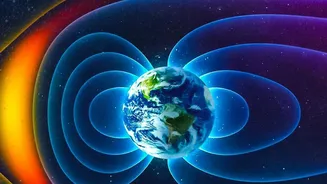
The ultimate goal of studying the Sun is to better protect our technology-dependent civilisation. Earth-directed CMEs can trigger geomagnetic storms, which pose a serious threat to our modern infrastructure. These storms can disrupt satellite operations, damage communication networks, interfere with GPS navigation, and even cause widespread blackouts by overwhelming power grids. By improving our understanding of how CMEs are born and how they travel, Aditya-L1 provides crucial data that helps refine space weather alerts. More accurate forecasts give satellite operators and grid managers valuable lead time to take protective measures, safeguarding the systems we rely on every day.