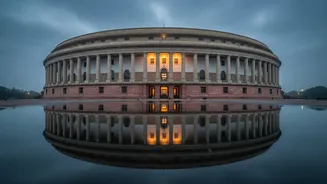









The Staggering Financial Drain
Every minute that Parliament is in session costs the public exchequer an estimated ₹2.5 lakh. This figure, while based on a 2012 calculation and likely higher today, covers salaries, security, maintenance, and administrative support. When disruptions
lead to adjournments, the meter keeps running. A full six-hour day of a stalled Parliament can translate to a loss of around ₹9 crore. For instance, in one recent session, just three days of disruptions in both Houses were estimated to have cost the taxpayer around ₹23 crore. This is not just a notional loss; it is public money spent with zero productive output, money that could have been used for essential services.
A Halt on Law-Making
The most direct consequence of parliamentary logjams is the delay in passing crucial legislation. Bills that address everything from economic reforms and public health to social issues and national security get stuck in limbo. For example, during some sessions, crucial bills have been passed with minimal or no debate, sometimes in a matter of minutes, simply to clear the agenda amid chaos. This not only compromises the quality of laws but also means that urgent national problems go unaddressed. The 17th Lok Sabha (2019-2024) held the lowest number of sittings for any full-term Lok Sabha, and productivity has often plummeted during contentious sessions, with some functioning at less than 30% of their scheduled time.
The Erosion of Accountability
Parliament is not just a law-making factory; it is the primary body for holding the government accountable. The most powerful tool for this is the Question Hour, the first hour of every sitting where Members of Parliament (MPs) can directly question ministers on their policies and actions. Disruptions frequently wash out this critical hour. In some sessions, Question Hour has functioned for as little as 1% to 12% of its allotted time. When MPs cannot ask questions, ministers are not compelled to provide answers, and the government can effectively evade scrutiny on pressing issues. Similarly, Zero Hour, an Indian innovation where MPs raise urgent matters of public importance, is also lost, silencing important regional and national concerns.
Weakening Debate and Scrutiny
Robust debate is the cornerstone of a healthy democracy. When bills are passed without discussion, it robs the legislative process of diverse perspectives and expert input. This bypasses a crucial quality-check mechanism, increasing the risk of flawed laws that may later face legal challenges or public opposition. Furthermore, disruptions have contributed to a worrying trend: a decline in the number of bills referred to Parliamentary Standing Committees. These committees are 'mini-Parliaments' where MPs from all parties, away from the public glare, conduct detailed, clause-by-clause scrutiny of legislation, consult experts, and build consensus. When this vital step is skipped, laws are passed without the necessary rigour and examination.