





A World Full of Surprises
Ever since NASA's New Horizons spacecraft flew past Pluto in 2015, it has been rewriting the book on what we thought we knew about dwarf planets. Instead of a quiet, cratered ice ball, the probe revealed a world with towering mountains of water ice, a thin
but extended nitrogen atmosphere, and a stunning, heart-shaped glacier of frozen nitrogen larger than Texas and Oklahoma combined. This massive feature, known as Sputnik Planitia, shows signs of geologic activity, with the surface appearing remarkably young and free of craters, suggesting it is constantly being renewed. This finding alone pointed to a world that was far from dead.
The Heart of the Discovery
The focus of the latest research is on the northern edge of Sputnik Planitia. Here, images from New Horizons show a landscape of city-sized convection cells, where the solid nitrogen ice slowly churns over millions of years. Separating these cells are dark, linear cracks and more diffuse patches. For years, scientists have puzzled over these features. A recent study, published in the Planetary Science Journal, provides a compelling new theory: these dark features may be the result of liquid nitrogen temporarily wetting the surface.
How Can Liquid Exist in Such Cold?
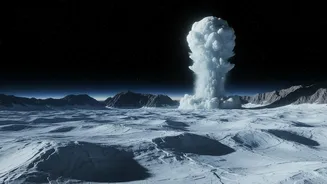
The idea of liquid on Pluto, where surface temperatures are incredibly low, sounds impossible. Liquid nitrogen rain is physically impossible under Pluto's atmospheric conditions. The new theory doesn't suggest rain, but rather a process from below. Scientists propose that deep beneath the kilometers-thick nitrogen glacier, the immense pressure, combined with modest heat from Pluto's interior, could be enough to melt the nitrogen ice at its base, creating reservoirs of liquid nitrogen. This liquid, being less dense than the solid ice above it, would be buoyant and could be forced upward through cracks and conduits, much like magma on Earth.
An Earthly Comparison
Once this subsurface liquid reaches the surface, computer models show it could remain in a liquid state long enough to flow and spread before refreezing. As it flows, it would 'wet' the surrounding solid nitrogen ice, causing it to darken. To support this idea, researchers compared the New Horizons images to satellite photos of Greenland's ice sheet. On Earth, when liquid water from melt emerges on the surface of ice and snow, it creates similar dark, wetted patterns. This comparison, while not definitive proof, strengthens the argument that similar physical processes involving liquids are at play on Pluto.
A Dynamic and Evolving World
This research paints a picture of Pluto as a geologically active world. The process isn't necessarily happening constantly; scientists believe the liquid nitrogen may build up over time and erupt to the surface periodically. The term "recent" in geology can mean within the last million years, but it implies this is an ongoing process that continues to shape Pluto's landscape today. As Alan Stern, principal investigator of the New Horizons mission, stated, "Pluto never stops surprising us." This finding suggests that Pluto has a kind of active, time-variable 'plumbing' system under its ice, a feature seen nowhere else in the same way. It forces us to reconsider the conditions under which liquid can exist in the outer solar system and hints that similar processes might be occurring on other distant, icy bodies like Neptune's moon Triton.