




A Sweet Discovery in Deep Space
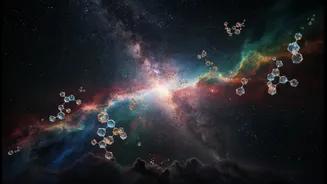
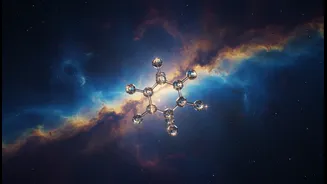
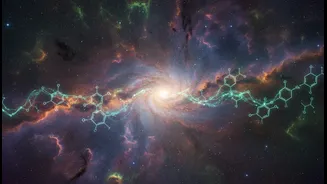
An international team of astronomers has announced the first-ever detection of a true sugar in interstellar space. The molecule, called erythrulose, was found in a sprawling molecular cloud near the center of our Milky Way galaxy, some 27,000 light-years
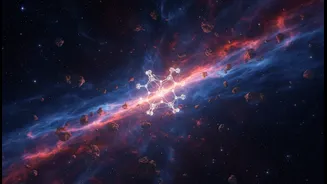
from Earth. While it may share a name with the crystals in your sugar bowl, this isn't something you'd stir into your tea. Erythrulose is a four-carbon sugar, a much simpler version, but one that belongs to the same chemical family as the sugars that form the backbone of DNA and RNA. This finding is more than a cosmic curiosity; it's a profound piece of evidence in the search for how life begins.
Why This Sugar Is So Important
Sugars are fundamental to life as we know it, serving as energy sources and, crucially, as structural components of our genetic material. Scientists have long wondered how these vital molecules could have formed on early Earth, as lab experiments simulating prebiotic conditions often produce them in only tiny amounts. The discovery of sugars in meteorites that have crashed on Earth has long suggested they might have an extraterrestrial origin. Finding erythrulose floating freely in the interstellar medium—the stuff from which new stars and planets are born—is a landmark moment. It proves that these essential building blocks can form in the cold, harsh vacuum of space, long before planets even exist.
A Cosmic Delivery Service
This discovery breathes new life into the theory known as panspermia, which posits that life on Earth may have been seeded with ingredients from space. The idea is that comets and asteroids, which are leftover material from the formation of the solar system, could have acted as a cosmic delivery service. These bodies would have swept through clouds like the one where erythrulose was found, picking up prebiotic molecules. During Earth's early, chaotic history, a period known as the Late Heavy Bombardment, our planet was pummeled by these comets and asteroids. It’s now believed that millions of tonnes of these sugars could have arrived on the young Earth, providing a ready-made starter kit for biology to emerge.
Reading the Cosmic Fingerprints
Detecting a specific molecule across thousands of light-years is an incredible feat of scientific detective work. Astronomers used powerful radio telescopes in Spain to make the discovery. Every molecule, like a fingerprint, absorbs and emits light at a unique set of frequencies. By pointing the telescopes at the molecular cloud, scientists could analyze the faint radio waves passing through it. They identified 12 distinct spectral lines that exactly matched the signature of erythrulose, confirming its presence. This technique allows researchers to take a chemical inventory of distant stellar nurseries, revealing the ingredients available for future solar systems.
Deepening the Mystery
While a monumental step forward, the discovery of erythrulose also introduces a new puzzle. Prevailing theories of astrochemistry suggested that complex molecules in space form by adding one carbon atom at a time. However, the team found that erythrulose, a four-carbon sugar, was surprisingly more abundant than simpler three-carbon sugars. This defies expectations and suggests there may be another, more efficient chemical pathway at play. Researchers now theorize that erythrulose might form when two smaller, two-carbon molecules combine on the icy surfaces of dust grains. This finding doesn't solve the mystery of life's origin, but it sharpens the questions we need to ask about the chemistry of the cosmos.