






The Charkha as a Symbol of Freedom
Before the tricolour we know today, the flags of the freedom struggle were powerful symbols of resistance. The Swaraj flag, proposed by Mahatma Gandhi in the 1920s, prominently featured the charkha. For Gandhi, the spinning wheel was more than a simple
device; it was the embodiment of Swadeshi, or self-reliance. It represented economic independence from British textiles, the dignity of labour, and a vision of India built from its villages upward. The charkha was a call to action, urging Indians to spin their own yarn and, in doing so, spin their own destiny. This symbol became central to the identity of the Indian National Congress and the non-violent struggle for independence.
The Debate in the Constituent Assembly
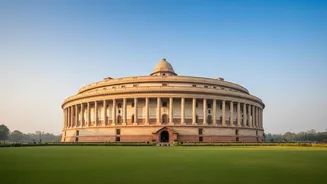
On July 22, 1947, just 24 days before India's independence, the Constituent Assembly met to finalise the design of the national flag. The ad-hoc committee, which included luminaries like Dr. B.R. Ambedkar and Sarojini Naidu, had a momentous decision to make. Jawaharlal Nehru presented the resolution for the tricolour, but with a significant change: the charkha was to be replaced by a wheel, the Ashoka Chakra. The reasons were both practical and philosophical. Nehru noted that a flag with the charkha would be asymmetrical; it would look different on the reverse side. The Chakra, however, was perfectly symmetrical.
From Self-Reliance to Eternal Law
The change was far more than aesthetic. While the charkha was deeply tied to the specifics of the freedom movement, leaders wanted a symbol that was more universal and timeless. They found it in the 'Dharma Chakra' from the Lion Capital of Emperor Ashoka at Sarnath, dating back to the 3rd century BCE. This 'Wheel of Law' represented a different vision for India. It stood for dharma (righteousness), justice, and constant movement. As Sarvepalli Radhakrishnan, India's future second President, explained, the Chakra represented the rule of law and the idea that there is life in movement and death in stagnation. It was a symbol that connected the new nation to its ancient past while signalling a commitment to progress and modern statehood.
The Meaning of the 24 Spokes
The navy blue Ashoka Chakra features 24 spokes, each carrying its own layer of symbolism. While there is no single official interpretation, the spokes are often seen as representing 24 virtues or principles, such as love, courage, peace, and righteousness, guiding the nation. They are also interpreted as representing the 24 hours of the day, a constant reminder of the duty to move the nation forward without pause. This interpretation reinforced the idea that the new India would be a dynamic entity, always striving for progress and ethical governance. The symbol was chosen to represent a nation committed to moving forward on the path of law and morality.
A Bittersweet Transition
The decision was not without controversy. Mahatma Gandhi, who had first conceived of the charkha on the flag, was deeply unhappy with the change. He reportedly stated that if the flag did not embody the emblem of the charkha, he would refuse to salute it. For him, removing the spinning wheel felt like a departure from the core values of Swaraj and the empowerment of the masses. However, Nehru and others assured him that the spirit of the charkha was still represented in the wheel. Ultimately, Gandhi accepted the decision, and the Constituent Assembly unanimously adopted the new design, creating the flag that would be hoisted for a free India.