


Our Solar System's Odd Couple
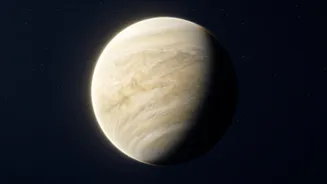
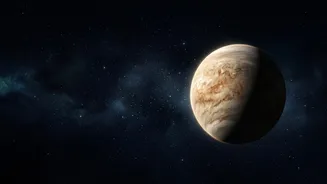
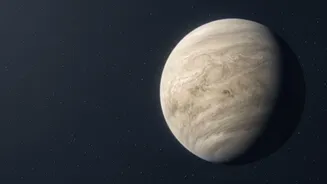
In the family of planets orbiting our Sun, Earth and Venus are the siblings that took wildly different paths. They are remarkably similar in size, mass, and overall structure, leading many to label Venus as Earth's twin. But the similarities end there.
Venus is the hottest planet in the solar system, with surface temperatures that can melt lead and a thick, toxic atmosphere. One of its most perplexing features is its rotation; a single day on Venus lasts 243 Earth days, which is longer than its entire year. It also spins backward compared to most other planets. And while Earth has a large, steady companion in its Moon, Venus travels the cosmos alone. This cosmic solitude has long been a puzzle for planetary scientists.
A Tale of Two Tides
To understand how Venus might have lost a moon, we first need to look at Earth's relationship with its own. The gravitational pull between Earth and the Moon creates tides. Crucially, because Earth rotates relatively quickly—once every 24 hours—it transfers rotational energy to the Moon. This process acts like a gentle, continuous push, causing our Moon to drift farther away from us by about four centimetres every year. Scientists have been able to measure this with incredible precision using mirrors left on the lunar surface during the Apollo missions. This interaction slows Earth's rotation over geological time while pushing the Moon into a more distant orbit. For a planet-moon system, a fast spin means pushing your satellite away.
The Deadly Gravitational Embrace
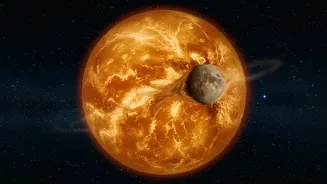
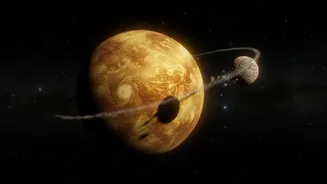
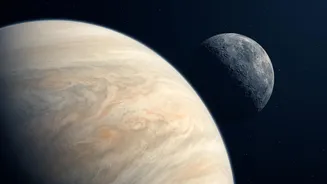
A new study from University of California, Riverside, astrophysicist Stephen Kane suggests that Venus's situation was the exact opposite. Using computer simulations, Kane and his team explored what would happen if Venus once had a moon. They modelled the physics of their gravitational interactions, first confirming their model worked by accurately reproducing the evolution of the Earth-Moon system. Then, they applied it to Venus. Because Venus spins so incredibly slowly, the tidal forces would work in reverse. Instead of pushing a moon away, the planet's sluggish rotation and powerful gravity would pull the moon inward, causing its orbit to decay over millions of years. This creates a scenario where the planet itself, without any external disaster, dooms its own satellite.
Simulating a Cosmic Collision
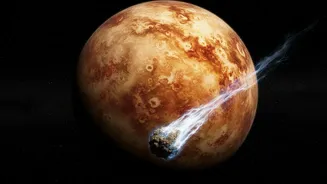
The research, published in The Astrophysical Journal, tested a wide range of scenarios with hypothetical moons of various sizes and different planetary rotation speeds. The results were surprisingly consistent: in most simulations, the moon spiralled inward until it ultimately crashed into Venus. The models showed that more massive moons would have met this fate even faster. According to Kane, the study demonstrates that Venus didn't require a catastrophic external event—like being hit by a giant asteroid that shattered its moon—to explain its current state. The planet's own physics could have naturally caused its moon to collapse back onto it. This theory presents a non-catastrophic explanation for a long-standing mystery.
What the Lost Moon Explains
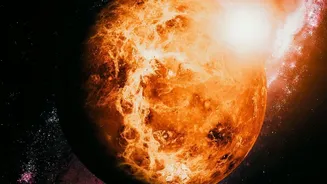
While the simulations don't prove Venus definitely had a moon, they show that if one did form, it would have been incredibly difficult to keep. The collision would have been a planet-altering event, transferring an enormous amount of energy and momentum. This could help explain some of Venus's other oddities, such as its exceptionally slow rotation and the potential trigger for the runaway greenhouse effect that makes it so inhospitable today. Finding direct evidence of this ancient collision is difficult, as a major resurfacing event about a billion years ago appears to have erased much of Venus's older geological history. However, chemical traces in the atmosphere or structures deep within the planet, similar to those found on Earth from its own moon-forming impact, could one day provide clues.