








The Insatiable Appetite of AI
Generative AI models, with their billions of parameters, are fundamentally different from traditional computing workloads. They require immense computational power, primarily from power-hungry Graphics Processing Units (GPUs), to train and operate. This
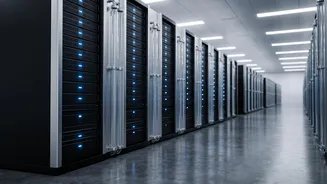
translates into staggering energy consumption. Training a single large AI model can consume as much electricity as hundreds of homes for a year. Consequently, an AI data centre can consume vastly more energy than a conventional one, with racks of servers drawing anywhere from 50 to 100 kilowatts (kW) or more—an order of magnitude higher than their predecessors. This extreme power density not only strains a facility's electrical systems but also has a cascading effect on regional power grids, with a single large-scale AI data centre potentially consuming as much energy as a small city.
Moving Beyond a Single Metric
For years, the gold standard for measuring data centre efficiency has been Power Usage Effectiveness (PUE). Developed by The Green Grid, PUE is a simple ratio: total facility power divided by the power used by IT equipment. A score of 1.0 is the theoretical ideal, meaning all power goes directly to computing. While modern hyperscale facilities achieve impressive PUE scores between 1.10 and 1.20, the metric only tells part of the story. The intense heat generated by AI workloads has brought other critical resources into focus, namely water. Water Usage Effectiveness (WUE), which measures litres of water consumed per kilowatt-hour of IT energy, has become an equally vital metric. Many efficient cooling systems use water, creating a direct trade-off: lowering energy use (and improving PUE) can sometimes increase water consumption, a significant concern in water-scarce regions. This has led to a more holistic view that also includes Carbon Usage Effectiveness (CUE), providing a clearer picture of a facility's true environmental footprint.
The Race to Keep Cool
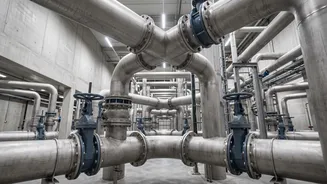
With high power comes high heat. Traditional air-cooling methods, which involve circulating cold air through server aisles, are hitting the limits of physics when faced with the thermal loads of modern AI chips. As a result, the industry is rapidly pivoting to liquid cooling. This isn't a new concept, but its application in data centres at scale is a game-changer. Direct-to-chip liquid cooling involves circulating a coolant through cold plates attached directly to the hottest components like GPUs. This method is thousands of times more effective at transferring heat than air, allowing for much higher server density and improved performance. Companies like Microsoft are pushing the envelope even further with microfluidics, etching tiny channels directly into the silicon to bring the coolant into direct contact with the chip, promising even greater efficiency gains. This shift is so fundamental that building a new data centre today without liquid cooling capabilities is seen as guaranteeing its premature obsolescence.
Smarter Hardware and Software
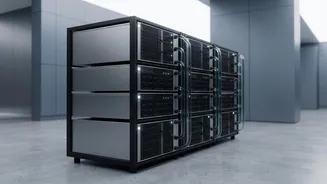
Beyond cooling, efficiency is being pursued at every layer of the stack. At the hardware level, the development of custom AI accelerators and specialized silicon by companies like Google and others is a key strategy. These chips are designed specifically for AI tasks, offering better performance per watt compared to general-purpose GPUs. On the software side, optimizing AI models is crucial. Researchers are finding ways to make models smaller and more efficient without sacrificing accuracy, a process that can significantly reduce the computational resources needed for both training and inference. Using AI itself to manage data centre operations is another growing trend. Predictive analytics can anticipate workload fluctuations, dynamically allocating power and cooling resources to reduce waste and identify underutilized servers.
The Imperative for India
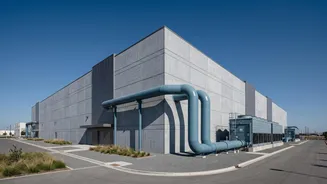
India's data centre market is in a phase of explosive growth, with capacity projected to triple by 2029. This expansion is driven by cloud adoption, data localisation mandates, and a surge in AI workloads. For India, which is poised to be a major player in the global AI landscape, getting the efficiency angle right is not just an option—it's a strategic necessity. The country's ambitious goal of adding 500 GW of renewable energy capacity by 2030 is directly tied to powering this digital transformation sustainably. The market is already seeing a push for energy-efficient hardware and next-generation facilities, particularly along the Mumbai-Bangalore corridor. As billions in investment pour into building new capacity, focusing on advanced cooling, renewable power, and holistic efficiency metrics will be critical for ensuring this growth is both economically viable and environmentally responsible.