







A World Reimagined
Before NASA's New Horizons spacecraft flew past Pluto in July 2015, our best images showed little more than a fuzzy, distant sphere. Scientists largely expected to find a geologically dead world, pockmarked by ancient craters and frozen solid for billions
of years. The reasoning was simple: small, distant bodies were thought to have lost their internal heat long ago, leaving them inert. The groundbreaking images from New Horizons shattered this old picture, revealing a world of stunning complexity with towering ice mountains, vast smooth plains, and signs of an active surface. The most famous of these features is Tombaugh Regio, a bright, heart-shaped region of frozen nitrogen that appeared remarkably free of impact craters, a clear sign that its surface was geologically young.
The Case for Liquid Nitrogen
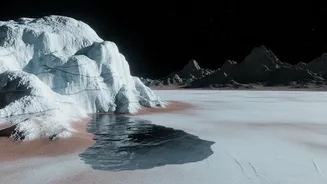
The latest and most compelling evidence for a changing Pluto comes from a recent analysis of images from 2015. A study led by the Southwest Research Institute (SwRI) and published in the Planetary Science Journal provides evidence that liquid nitrogen may have recently flowed on the surface. Researchers examining the northern edge of the heart-shaped Sputnik Planitia glacier noticed dark streaks and patches along the boundaries of large, city-sized convection cells of ice. These patterns closely resemble features on Earth's ice sheets where liquid water has welled up from below and wetted the surface. Since Pluto's thin atmosphere makes nitrogen rain impossible, the team concluded that liquid nitrogen is likely seeping up through cracks from beneath the glacier. Computer models support this, showing that nitrogen ice at the base of the kilometers-deep glacier could melt and be forced to the surface.
Volcanoes of Ice
Beyond flowing nitrogen, scientists have also identified enormous structures that appear to be cryovolcanoes—volcanoes that erupt a slushy mix of water, ammonia, or methane instead of molten rock. Two prominent candidates, Wright Mons and Piccard Mons, are huge mountains tens of kilometers across with deep depressions at their summits, much like volcanoes on Earth. Analysis of the area around these mounds suggests they were formed by relatively recent eruptions, possibly within the last billion years. This is considered recent in geological terms and implies that Pluto has retained enough internal heat to power this activity, a surprising finding for such a small, cold world. The existence of cryovolcanism points to a warmer interior than previously thought, fundamentally changing our understanding of how icy worlds evolve.
A Land of Icy Landslides
Further proof of Pluto's dynamic nature comes from the discovery of massive landslides. In July 2026, a team announced they had identified the aftermath of six large landslides within craters on the western edge of Sputnik Planitia. These are not small events; some are large enough to bury entire cities on Earth. The debris from these slides traveled for many kilometers across the crater floors, a journey enabled by Pluto's low gravity and low-friction icy rubble. The discovery of these features, the first of their kind found on Pluto, adds another layer to the evidence that the dwarf planet's surface is actively being sculpted and changed. The landslides, cryovolcanoes, and flowing nitrogen all paint a picture of a world that is far from static.
What Powers a Dynamic Pluto?
The big question raised by all this activity is: where does the energy come from? A small world like Pluto, so far from the sun, should have frozen solid eons ago. Scientists are exploring several possibilities. One theory is that Pluto retains heat from its formation. Another is that the slow decay of radioactive elements in its rocky core provides a steady source of warmth, enough to maintain a subsurface ocean of liquid water and ammonia. This hidden ocean, insulated by a thick crust of ice, could be the engine driving much of the geological activity we see on the surface. The presence of ammonia, which acts as an antifreeze, mixed with water ice in some cryolava flows, supports the idea of a liquid reservoir deep below. Whatever the source, it is clear that Pluto has an internal plumbing system that continues to shape its surface.