


Eyjafjallajökull, Iceland (2010): The Ash Cloud That Halted Air Travel
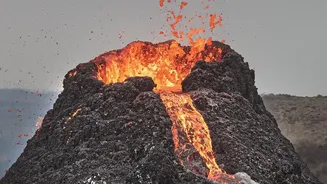
In April 2010, a relatively obscure Icelandic volcano with an unpronounceable name, Eyjafjallajökull, became a household word for all the wrong reasons. Its eruption wasn't the largest in terms of explosive power, but its impact was uniquely modern. The
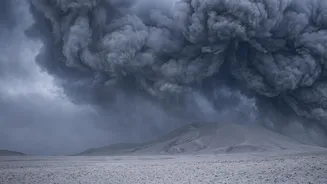
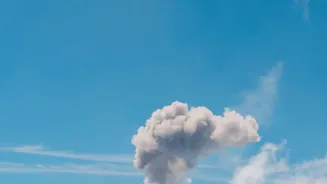
eruption occurred beneath a glacier, a combination that created incredibly fine, abrasive ash particles. Carried by prevailing winds, this massive ash cloud drifted directly over Northern Europe, home to some of the world's busiest air corridors. For six days, airspace across the continent was shut down, representing the largest disruption to air travel since World War II. Over 100,000 flights were cancelled, stranding millions of passengers and causing an estimated economic loss of billions. The event served as a stark wake-up call, demonstrating how a single, moderately-sized eruption could sever the arteries of our interconnected global transportation network. It forced the aviation industry to completely reassess the risks posed by volcanic ash, leading to new detection methods and engine tolerance standards.
Hunga Tonga-Hunga Haʻapai, Tonga (2022): The Blast That Touched Space
The eruption of the Hunga Tonga-Hunga Haʻapai submarine volcano on January 15, 2022, was an event of historic proportions. It stands as the largest and most powerful volcanic explosion of the 21st century to date, with a force hundreds of times stronger than the atomic bomb dropped on Hiroshima. The blast sent atmospheric shockwaves circling the globe multiple times and generated a sonic boom heard as far away as Alaska. Being an underwater eruption, it also triggered a devastating tsunami that impacted the Tongan archipelago and sent waves across the Pacific. What made this event scientifically unprecedented was the sheer volume of water vapor—an estimated 150 teragrams—it blasted into the stratosphere, increasing the total water content at that altitude by about 10%. This was the highest plume ever recorded, reaching over 50 kilometres in altitude. Scientists are still studying the long-term effects of this massive water vapor injection on atmospheric chemistry and the ozone layer, making the Tonga eruption a unique natural laboratory.
Puyehue-Cordón Caulle, Chile (2011): A Disruption for the Southern Hemisphere
A year after Iceland’s travel chaos, the Southern Hemisphere experienced its own volcanic paralysis. In June 2011, the Puyehue-Cordón Caulle volcanic complex in Chile roared to life after 51 years of inactivity, producing one of the century's other major eruptions. It ejected an estimated one hundred million tons of ash, sand, and pumice into the atmosphere. The resulting ash cloud was vast, circling the entire globe in about two weeks. It caused widespread and prolonged disruption to air travel across South America, South Africa, Australia, and New Zealand. Cities like Buenos Aires, Melbourne, and Auckland saw flights grounded for days, creating travel chaos for hundreds of thousands of people. The eruption had a severe impact beyond aviation, affecting agriculture, tourism, and public health in the surrounding regions of Chile and Argentina. This event underscored that the lessons from Eyjafjallajökull were not just a European problem, but a global vulnerability.
Mount Merapi, Indonesia (2010): The Human and Social Toll
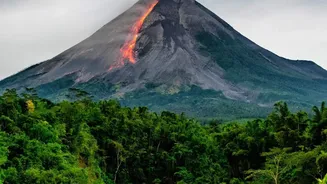
While other eruptions impacted global systems, the 2010 eruption of Mount Merapi in Indonesia was a powerful reminder of the immediate and devastating human cost of volcanic activity. As one of Indonesia's most active and dangerous volcanoes, Merapi is located in a densely populated area of Java. The eruption was its most powerful in decades, leading to the deaths of over 350 people and forcing the displacement of more than 350,000 residents. Entire villages were buried under pyroclastic flows and heavy ashfall. Beyond the immediate destruction, the event had long-lasting social and economic consequences. It devastated local agriculture, though the ash deposits eventually led to more fertile soil in the long run. The disaster also spurred significant social change, as communities were rebuilt and many former farmers shifted into new livelihoods, such as a booming local tourism industry built around the eruption site.