






Breaking Down the Record Numbers
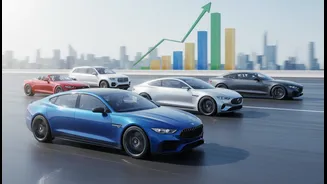
The latest data from the Society of Indian Automobile Manufacturers (SIAM) reveals a landmark performance for the April-June 2026 quarter. Passenger vehicle sales, a key metric, soared to 1.27 million units, a staggering 25.9% increase compared to the same
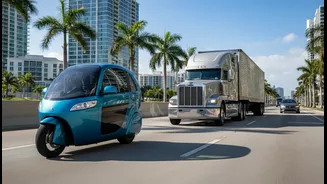
period last year. This wasn't an isolated event; the growth was remarkably broad-based. Two-wheeler sales climbed by over 20% to 5.63 million units, while three-wheelers saw a nearly 30% jump to 214,339 units. Even the commercial vehicle segment, often seen as a direct barometer of industrial activity, posted a healthy 18.3% growth, reaching a record 265,000 units for the quarter. The total volume across all segments surpassed 7.3 million vehicles, marking a robust 21.4% year-on-year growth and setting a new benchmark for the first quarter.
The Engine Behind the Growth
Several factors are fueling this impressive momentum. According to industry leaders, supportive government policies, including the impact of GST 2.0, have helped keep vehicle costs in check. This has been coupled with softer financing costs, making it easier for consumers to commit to big-ticket purchases. The introduction of a wave of new models across various segments has also successfully captured buyer interest. Furthermore, the industry is benefiting from a steady demand environment that has remained resilient despite some global headwinds. While a low base effect from the previous year plays a part, the sheer scale of the growth points to more fundamental strengths at play in the domestic market.
A Barometer of Consumer Confidence
A thriving auto market is one of the clearest signs of positive consumer sentiment. The decision to purchase a new vehicle is often a household's second-largest financial commitment after buying a home. When sales are this strong across the board—from commuter two-wheelers to family SUVs and commercial trucks—it signals that a significant portion of the population feels secure about their financial present and optimistic about the future. People are willing to spend because they have confidence in their job security and income stability. While the Reserve Bank of India's official July 2026 consumer confidence survey results are still pending, these sales figures serve as a powerful real-world proxy, suggesting that underlying demand remains firm.
A Boost for Domestic Manufacturing
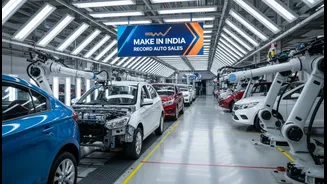
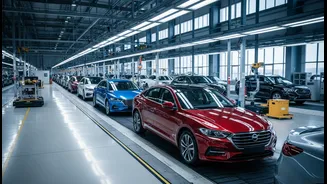
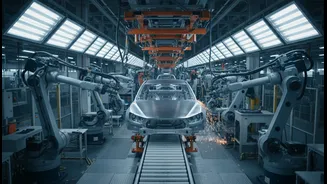
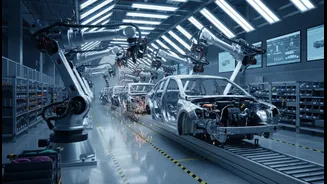
You can't sell cars that haven't been built. The surge in auto sales directly translates into a massive boost for India's manufacturing sector. To meet this demand, factories have been running at high capacity. Production of utility vehicles, the dominant force in the passenger car market, grew by over 21% in the quarter. This ripple effect extends far beyond the major auto brands, energizing a vast ecosystem of ancillary industries that produce everything from tyres and batteries to steel and electronic components. While the broader HSBC India Manufacturing PMI for June showed a slight moderation in growth to a still-strong 54.2, the auto sector's performance provides a powerful counterbalance, highlighting the strength concentrated in domestic consumer goods. The record quarter reinforces the 'Make in India' narrative, showcasing the country's capacity to produce complex goods at scale.
The Road Ahead
The industry is looking ahead with cautious optimism. With the festive season approaching, which traditionally sees a spike in purchases, manufacturers expect the steady demand to continue. Electric vehicles (EVs) are also becoming a significant part of the story, accounting for over 10% of total vehicle sales in the quarter, with sales surging over 52% year-over-year. However, there are potential bumps in the road. Industry bodies like SIAM are keeping a close watch on the progress of the monsoon, as it heavily influences rural demand, which is critical for the two-wheeler and small car segments. Rising commodity costs also remain a pressure point for manufacturers, potentially impacting pricing and margins in the coming months.