






More Than Just a Handle
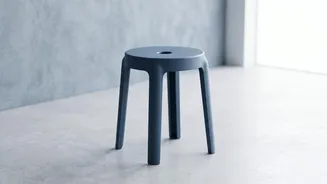
The most common assumption about the hole is that it’s simply a handle to make the stool easier to carry. While it certainly serves that purpose, allowing you to slip your fingers through for a quick and balanced grip, that’s only part of the story. The convenience
of being able to pick it up with one hand is a clear benefit, especially when moving multiple stools, but this simple opening is the result of much cleverer engineering that solves several problems at once. It’s a feature designed for practicality, from storage to safety, proving that even the most ordinary objects can have a surprising amount of thought put into them.
Defeating Air Pressure and Vacuum
The primary scientific reason for the hole is to prevent a vacuum from forming when the stools are stacked. Plastic stools are designed to nest inside one another to save space. If the top surface were solid, a pocket of air would get trapped between two stacked stools. When you tried to pull them apart, this trapped air would create suction, making them stick together. This vacuum effect can be surprisingly strong, requiring significant force to separate them. The hole acts as a vent, allowing air to flow freely between the stools. This simple addition breaks the seal, equalizing the pressure and allowing you to unstack them with ease. It’s a small detail that makes a huge difference in any situation where multiple stools are stored, from event halls to the corner of a storeroom.
Structural Integrity and Smart Design
The shape of the hole—almost always circular—is also intentional. Sharp corners or angles in a plastic design create points of concentrated stress. When someone sits down, their weight is distributed across the seat. On a solid stool, stress might build up in weak areas. A circular hole helps to distribute this pressure more evenly across the structure, reducing the risk of the plastic cracking or breaking under load. While the hole itself doesn't necessarily make the stool stronger (that depends on the overall design and material thickness), its round shape is the most effective way to create an opening without introducing weak points. It’s a classic engineering principle: avoiding sharp angles to improve durability.
Efficiency in Manufacturing
The hole also offers a key benefit during the manufacturing process itself. Plastic stools are typically made using injection molding or vacuum forming, where heated plastic is shaped in a mold. The inclusion of a hole means that slightly less plastic is needed for each stool. While the saving on a single unit is tiny, it adds up to a significant reduction in material and cost when producing millions of them. Furthermore, the hole can aid in the process of removing the stool from its mold. It helps prevent suction issues within the mold and ensures the product can be ejected smoothly without damage. It also provides a useful point for robotic arms to grab the stool on an automated production line.
A Bonus Feature: Drainage
Finally, the hole serves a very practical purpose for stools used outdoors or in wet areas like bathrooms. If a solid-seated stool is left out in the rain or used during washing, a puddle of water will collect on top. The hole provides a convenient drainage point, allowing water to pass straight through. This means the stool dries faster and is ready to use much sooner, preventing you from getting an unexpectedly wet seat. It’s another simple, practical benefit that makes the plastic stool such a versatile piece of furniture for both indoor and outdoor settings.