

Our Unavoidable Companions
Whenever humanity travels to space, we don't go alone. We are natural carriers of a vast ecosystem of microorganisms. A patch of skin the size of a pencil eraser can host a million bacteria, and these tiny lifeforms inevitably vent from spacesuits and habitats.
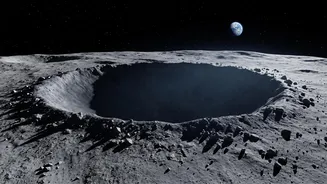
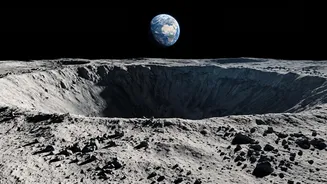
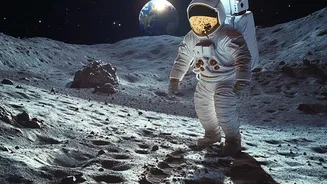
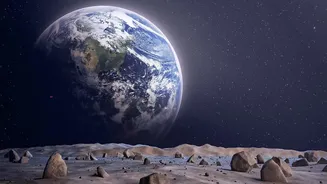
This means that with every bootprint and rover track, we leave a biological signature. While the Apollo missions landed near the Moon's equator, where intense radiation and heat were thought to destroy any biological hitchhikers, upcoming missions like Artemis are targeting the lunar south pole. This region is vastly different, featuring craters with areas of permanent shadow that offer protection from the sun's harsh realities.
The Science of Survival
A study recently published in Science Advances modeled how certain Earth microbes would fare in the unique conditions of the lunar south pole. Researchers analyzed data from NASA's Lunar Reconnaissance Orbiter, mapping temperature and ultraviolet radiation levels across the landscape, including in the shadows cast by craters and ridges. They then simulated the survival chances for five microbes commonly found on spacecraft, including the fungus Aspergillus niger and the bacterium Deinococcus radiodurans. The results were surprising: the models showed that there are significant "survivable niches" where these organisms could persist in a dormant state. While they wouldn't grow or reproduce, they could remain viable. The key is the protection offered by topography. In these shadowed regions, microbes are shielded from the extreme temperatures and lethal UV radiation that sterilize most of the lunar surface.
Meet the Toughest Traveler
Aspergillus niger, a common black mold found in damp places like bathrooms and even inside the International Space Station, proved to be the hardiest of the group. Its dark pigments and thick cell walls give it remarkable resistance to radiation. The simulations showed it could potentially survive for a week or more in certain shaded areas. During the lunar winter, its potential survivable habitat could cover 15% to 30% of some mapped areas that still receive a bit of sunlight. Even other, less-resilient microbes were found to have potential survival zones in permanently shadowed craters, where they could last for at least a week. This finding is significant because many of these microbes are not considered "extremophiles"—organisms specifically adapted to the harshest environments on Earth—making their potential resilience on the Moon unexpected.
Implications for the Artemis Era
These findings have critical implications for the future of space exploration. As NASA's Artemis program prepares to send astronauts back to the Moon, with the goal of establishing a long-term presence, the issue of contamination becomes paramount. Planetary protection protocols are designed to prevent the forward contamination of other worlds and the backward contamination of Earth. The discovery that microbes could survive on the Moon complicates the scientific mission to study its pristine environment. Scientists want to analyze lunar soil for clues about the early solar system and the origins of life, but if the sites are contaminated with Earth life, it could become difficult to distinguish our microbes from anything that might have been there naturally. This makes it crucial to get baseline measurements before human activity changes the lunar landscape forever.
A Natural Laboratory or a Contamination Risk?
The scientific community views this challenge from two perspectives. On one hand, there is a serious concern about tainting a celestial body before we can fully study it. This concern extends to future missions to Mars, where the search for extraterrestrial life is a primary goal. On the other hand, some scientists argue that the Moon could serve as a unique natural laboratory. We could use it to study the absolute limits of microbial survival in an environment that cannot be perfectly replicated on Earth. Understanding how our own microbial companions fare in these extreme conditions could provide invaluable data for protecting astronauts on long-duration missions and for understanding the potential for life to exist elsewhere in the cosmos. The presence of these hardy microbes forces a deeper consideration of our role as explorers and our responsibility to the worlds we visit.