




A New Eye on the Cosmos
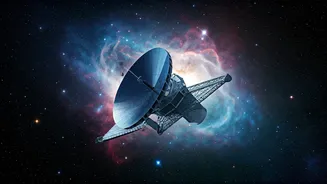
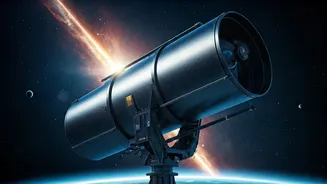
Scheduled for launch in August 2026, the Nancy Grace Roman Space Telescope represents a new chapter in space exploration. Named after NASA's first Chief of Astronomy, Dr. Nancy Grace Roman, who is often called the "mother of Hubble," this next-generation
observatory is designed not just to peer into the universe, but to survey it. While the Hubble and James Webb Space Telescopes are like looking at the sky through a pinhole, focusing intensely on small patches, Roman is built to see the big picture. It carries a 2.4-meter primary mirror, the same size as Hubble's, but its instrumentation is engineered for a completely different task.
Seeing the Bigger Picture
Roman's primary advantage is its colossal field of view. Its Wide Field Instrument (WFI) can capture an area of the sky at least 100 times larger than Hubble's infrared camera in a single shot, all with the same stunning clarity. This means a single image from Roman will contain the detail equivalent to 100 Hubble pictures stitched together. This panoramic capability will allow the telescope to map vast regions of the cosmos with incredible speed. Scientists estimate that tasks that would take Hubble thousands of years to complete, Roman will be able to accomplish in just one year. This shift from deep, narrow observations to wide, fast surveys will generate an unprecedented amount of data, creating a new, high-definition map of the universe for scientists to explore for decades.
Hunting for Cosmic Mysteries
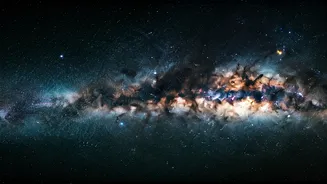
The mission has two primary science goals: to unravel the secrets of dark energy and to discover thousands of new exoplanets. Dark energy is the mysterious force believed to be causing the accelerating expansion of the universe. Roman will tackle this by conducting enormous surveys, mapping the 3D positions of hundreds of millions of galaxies and tracking thousands of exploding stars called supernovae. These observations will measure how the universe's expansion has changed over cosmic time, providing the most precise measurements of dark energy's effects to date. Simultaneously, Roman will conduct a massive census of planets outside our solar system. Using a technique called gravitational microlensing, it will monitor hundreds of millions of stars near the Milky Way's center. This method is sensitive enough to find planets smaller than Mars, as well as rogue planets that drift through space without a host star.
A Complement to Webb and Hubble
Roman is not a replacement for Hubble or Webb, but a powerful partner. While Webb excels at detailed, close-up studies of specific objects, Roman's strength lies in its ability to quickly scan huge areas of the sky. Roman will act as a cosmic surveyor, identifying unique and rare objects—like primordial galaxies or colliding neutron stars—that Webb can then investigate in greater detail. This synergy is crucial; Roman will provide the broad context and find the needles in the cosmic haystack, while Webb will provide the high-resolution follow-up. In addition to its main survey camera, Roman also carries a technology demonstration called the Coronagraph Instrument, designed to directly image giant exoplanets by blocking out the overwhelming light of their host stars—a capability a thousand times better than previous space-based coronagraphs.