


A Cosmic Trio Emerges
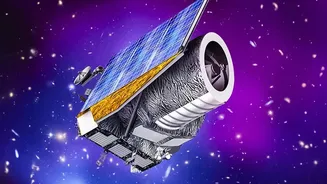
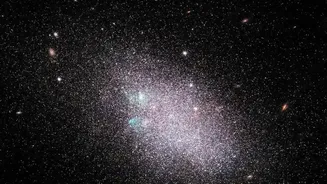
An international team of astronomers, using the powerful James Webb Space Telescope, peered into a galaxy known as J0148-4214. Because it is so distant, we are seeing it as it existed just 1.2 billion years after the Big Bang, a mere fraction of the universe's
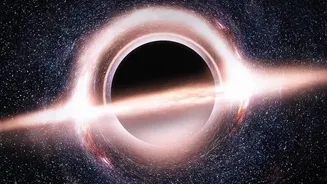
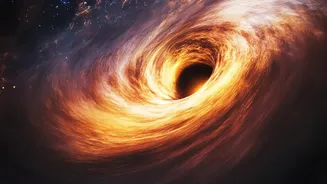
current age. Instead of the expected single black hole at its centre, they found three. Two are locked in a close cosmic dance near the galaxy's core, separated by only 620 light-years, and are expected to eventually merge. A third lurks further out, about 5,500 light-years from the central pair. This is the first time such a crowded system has been confirmed in the early universe.
The Puzzle of Rapid Growth
The existence of supermassive black holes in the early universe is one of cosmology's biggest mysteries. These objects, millions or even billions of times the mass of our sun, shouldn't have had enough time to grow so large. The standard theory involves a black hole slowly pulling in surrounding gas and dust. Another way is through the violent merger of two galaxies, which causes their central black holes to eventually combine. Both of these processes were thought to be relatively slow. Finding a galaxy with not just one, but three massive black holes suggests that the early universe was far more efficient at creating these giants than previously believed.
More Than Just a Fluke
The system in J0148-4214 is not just a curiosity; it's a natural laboratory. The masses of the three black holes vary significantly, with one weighing in at an estimated 80 million times the mass of our sun, while its smaller companions are about 2 million and 600,000 solar masses. All three are 'active', meaning they are voraciously consuming material from the galaxy, which causes the regions around them to blaze brightly. This suggests a chaotic, target-rich environment, likely the result of multiple galaxies crashing together. This finding provides strong evidence that these multi-galaxy pile-ups were a key method for rapid black hole growth in the cosmic dawn.
What This Means for the Cosmos
This discovery forces scientists to reconsider the early chapters of cosmic history. It implies that systems with multiple massive black holes were likely much more common than once thought. The 'crowded house' in J0148-4214 is a snapshot of a process in action—a preview of the massive black hole mergers that future gravitational wave observatories hope to detect. According to Hannah Übler, the lead author of the study, this discovery suggests that the processes in the early universe were efficient at bringing massive black holes together. It points to a more turbulent, dynamic, and faster-paced evolution for galaxies and the giants at their hearts.