


Why Your Desk Job Is Harming Your Hips
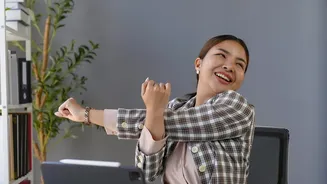
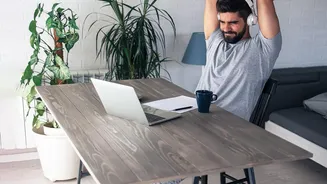
Our bodies are designed for movement, but the modern workday often involves spending eight or more hours in a chair. This prolonged sitting has a significant negative impact on your hips. When you're seated, your hip flexors—the group of muscles at the front
of your hip—are held in a shortened, contracted position. Over time, these muscles adapt, becoming tight and stiff. This tightness can pull your pelvis forward, leading to poor posture and often contributing to lower back pain. While your hip flexors are becoming tight, another crucial muscle group is switching off: your glutes. Extended periods of sitting can lead to what’s sometimes called 'gluteal amnesia' or 'dead butt syndrome,' where these powerful muscles weaken from inactivity. This imbalance—tight hip flexors and weak glutes—restricts your hips' overall range of motion, making simple movements like standing up or walking feel less fluid and sometimes even painful.
Yoga as the Perfect Countermeasure
The good news is that you can counteract the effects of a sedentary job. Yoga is uniquely suited to address the hip issues caused by sitting. It combines active and passive stretching with strengthening postures, directly targeting the imbalances created at your desk. Through specific poses, or asanas, yoga encourages tight muscles to lengthen and weak muscles to engage. This helps restore a healthy range of motion and promotes better pelvic alignment. By focusing on the hips, you not only alleviate local stiffness but also protect your lower back and knees, which often compensate for poor hip mobility. A regular yoga practice can bring fresh blood flow and awareness to this crucial area, improving your overall stability, balance, and quality of life.
Pose 1: Low Lunge (Anjaneyasana)
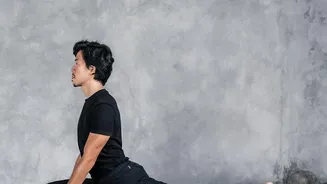
The Low Lunge is a fantastic stretch for the hip flexors, which become notoriously tight from sitting. Start by kneeling on the floor. Step your right foot forward so your right knee is directly over your ankle, creating a 90-degree angle. Slide your left knee back until you feel a comfortable stretch in the front of your left hip and thigh. Keep your hands on your front thigh for balance or, for a deeper stretch, raise your arms overhead, keeping your chest lifted. To avoid straining your lower back, gently tuck your pelvis. Hold for 30 seconds, breathing into the stretch, before carefully switching sides.
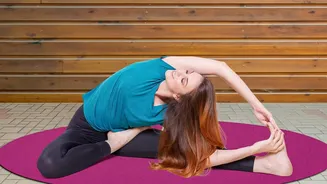
Pose 2: Pigeon Pose (Eka Pada Rajakapotasana)
Pigeon Pose is a deep hip opener that targets the outer hip and glute muscles. Begin on your hands and knees. Bring your right knee forward and place it behind your right wrist. Your right ankle should be somewhere in front of your left hip. Slide your left leg straight back, with the top of your foot resting on the floor. If your right hip is lifting off the ground, place a folded blanket or a block underneath it for support. You can stay upright on your hands or, for a more restorative version, fold your torso forward over your front leg. You should feel a stretch, but never sharp pain. Hold for at least 30 seconds to a minute before gently switching to the other side.
Pose 3: Lizard Pose (Utthan Pristhasana)
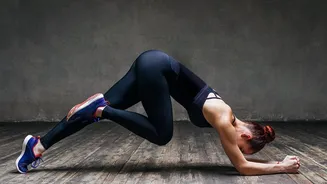
Lizard Pose is another intense hip flexor and inner thigh stretch that helps build strength and endurance in the hips. From a Low Lunge with your right foot forward, place both hands on the floor to the inside of your right foot. You can keep your back knee on the mat for support or lift it for a more active stretch. For a deeper sensation, lower down onto your forearms, either on the floor or on blocks. Keep your spine long and your gaze slightly forward. This pose provides a deep release, so breathe steadily through any discomfort. Hold for 30 seconds and then repeat on the left side.
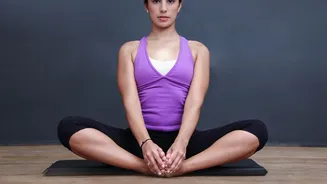
Pose 4: Bound Angle Pose (Baddha Konasana)
Also known as Butterfly Pose, this is a gentle yet effective stretch for the inner thighs and groin. Sit on the floor with your spine tall. Bring the soles of your feet together and let your knees fall out to the sides. The closer your heels are to your body, the more intense the stretch will be. Hold onto your ankles or feet and sit up straight. To deepen the stretch, you can gently hinge forward from your hips, keeping your back flat. Avoid rounding your spine. This pose is excellent for passively releasing tension after a long day of sitting and can be held for several minutes.