




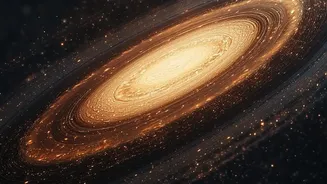
Our Galaxy's Ghostly Halo
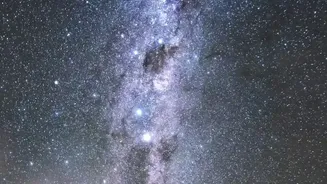
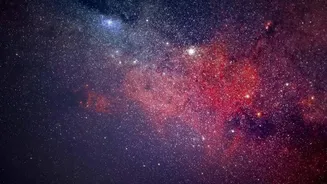
Beyond the familiar, glittering spiral arms of the Milky Way lies a vast, sparse sphere of ancient stars known as the stellar halo. This enormous but faint structure contains only a fraction of the galaxy's stars, but it holds the fossil record of our
cosmic home's assembly. Many of these halo stars weren't born in the Milky Way; they are the captured remnants of smaller, dwarf galaxies that were torn apart and absorbed over billions of years. Think of it as a ghostly cloud of immigrants, each carrying a story about where our galaxy came from and the violent encounters it survived to get here.
A Cosmic Speed Bump
For years, astronomers have been puzzled by this halo. While the stars in our galaxy's main disc, including our own Sun, zip around the galactic center at a brisk 220 kilometers per second, the stellar halo barely moves. Data from the European Space Agency's Gaia mission, which meticulously maps the positions and motions of billions of stars, confirmed that the halo rotates at a sluggish 10 to 20 kilometers per second. This discrepancy was a major mystery. Most simulations of galaxy formation predicted that halos should spin much faster as they absorb the momentum of the smaller galaxies they consume. The Milky Way's halo was an anomaly, and scientists needed to find out why.
The Prime Suspect: Gaia-Sausage-Enceladus
Recent research presented at the 2026 National Astronomy Meeting points to a prime suspect: a massive dwarf galaxy that collided head-on with the young Milky Way between 8 and 11 billion years ago. Astronomers have nicknamed this event the Gaia-Sausage-Enceladus (GSE) merger, a name inspired by the elongated, sausage-like shape that its remnant stars make when their velocities are plotted on a chart. This wasn't just a minor fender-bender; it was the last major merger in our galaxy's history and a truly transformative event. It's believed this single collision fundamentally reshaped the early Milky Way, creating the central bulge and contributing the bulk of the stars we now see in the inner halo.
Flipping the Galactic Disc
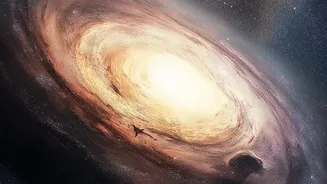
So how could this ancient crash explain the slow spin? Using powerful supercomputer models called the Auriga simulations, astronomers from Durham University ran the clock backward. They found that Milky Way-like galaxies that experienced a massive, head-on collision like the GSE merger often underwent a dramatic 'disc flip'. This doesn't mean the galaxy tumbled like a coin. Instead, the gravitational chaos from the merger gradually reoriented the entire plane of the spinning disc, tilting it by more than 90 degrees over hundreds of millions of years. According to lead researcher Kirill Batrakov, this process would have effectively cancelled out much of the angular momentum in the halo, leaving it with the slow, gentle rotation we observe today. The simulations showed that galaxies with the slowest-spinning halos were the most likely to have experienced both a major head-on merger and a subsequent disc flip.
Rewriting Our Cosmic History
This theory provides a compelling solution to a long-standing puzzle and deepens our understanding of how our galaxy was built. It suggests the trajectories of most stars in the Milky Way, possibly even our Sun, were once very different. While the GSE merger is the leading candidate for this dramatic event, other research continues to refine the timeline. Some studies point to evidence of a more recent event, dubbed the Virgo Radial Merger (VRM), happening within the last 3 billion years, which could also explain features seen in the halo. Disentangling these ancient events is complex, but each new piece of data from missions like Gaia allows astronomers to peel back the layers of time. The connection between the slow halo and a cataclysmic merger also provides clues about the invisible dark matter halo, which is thought to have evolved along with the stellar one.