






A simple accident in a Stanford University lab led to a stunning observation. When a dying, bleached coral fragment touched a healthy one, it sparked a recovery so rapid that it has reshaped what scientists thought possible for coral rescue.
A Fortunate Accident
It began with
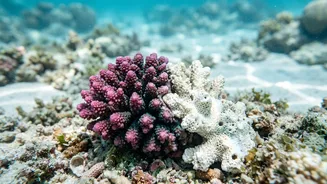
a moment of clumsiness that could happen in any lab. At Stanford's Hopkins Marine Station, a researcher was working with coral fragments in a tank when two of them, one healthy and one bleached ghostly white, accidentally tipped over and touched. What happened next was astonishing. Scientists watched as the healthy coral appeared to transfer its life-giving algae to its dying, genetically identical neighbor. The bleached coral began to regain its color, a process that unfolded 'basically in front of our eyes', according to one scientist. This accidental discovery kicked off a formal experiment to see if the phenomenon could be replicated, offering a potential new lifeline for corals on the brink of death.
The Science of a Simple Touch
Coral bleaching occurs when warming waters cause corals to expel the symbiotic algae living in their tissues, which provide them with essential nutrients and their vibrant color. Without these algae, the corals starve and become vulnerable. The Stanford experiment was designed to test the power of physical contact. Researchers paired bleached coral fragments with healthy fragments from the same parent colony. In every case where the two made physical contact, the bleached coral made a full recovery within seven weeks. Fragments kept just millimeters apart received no such help and eventually died. The study, published in 'Science Advances', confirmed that the corals' tissues fuse, allowing the healthy coral to send a flood of vital algae and nutrients to its struggling counterpart, kick-starting a rapid recovery process.
Unprecedented Recovery Speed
The speed of the recovery was the most remarkable finding. Researchers observed that during the second week of contact, the algae inside the recovering fragments doubled every four days—a rate roughly ten times faster than what is typically seen in the wild. In some cases, as little as five to seven days of contact was enough to transfer the necessary algae for the bleached coral to heal completely on its own. This is the fastest recovery from severe bleaching ever documented, a significant finding given that natural recovery can take months or even years, if it happens at all. The process demonstrates that even when corals appear close to death, they possess a surprising capacity for healing if given the right support.
From Stress to Spawning
This accidental discovery aligns with a broader understanding that stress can sometimes trigger unexpected survival mechanisms in corals. While the Stanford study focused on tissue fusion, other research has shown that physical or environmental stress can induce coral spawning—the release of eggs and sperm. Following a devastating marine heatwave in 2023, scientists in Florida embarked on an unprecedented effort to collect gametes from the few surviving elkhorn and staghorn corals. These 'survivor' corals, housed in offshore nurseries, provided the genetic material for creating a new generation of more heat-resilient offspring through a process often called 'IVF for corals'. More than 1.5 million coral embryos were created from this effort, a massive intervention made necessary by the widespread loss of wild populations.
Implications for a Fragile Future
While the 'touching' technique is currently limited to genetically identical corals in a lab, it opens a new door for restoration strategies. It could be used in nurseries to quickly revive corals that bleach during heatwaves, ensuring the survival of valuable genetic stock. This is especially critical for species like Florida's elkhorn and staghorn corals, which are now considered functionally extinct in the wild and rely on human intervention for reproduction. Scientists hope these new findings, from both accidental discoveries and massive rescue efforts, can be scaled up. The goal is to build a bank of resilient corals that can one day repopulate the world's struggling reefs, creating ecosystems better prepared for a changing climate.