






A Cosmic Detective Story
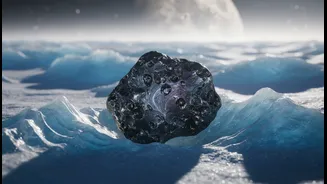
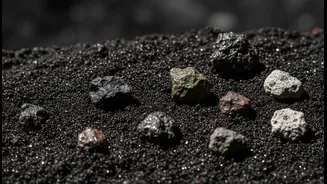
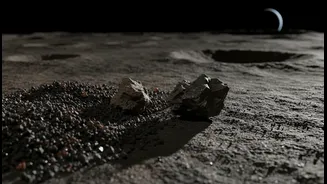
For decades, scientists have studied special rocks found in remote places like the deserts of Africa and the ice fields of Antarctica. These aren't ordinary rocks; they are lunar meteorites—pieces of the Moon blasted into space by ancient asteroid impacts
that eventually found their way to Earth. While these free samples from our celestial neighbour are invaluable, they come with a big question mark: where on the Moon did they come from? Without knowing their origin, it's hard to place them in the grand story of the Moon's geological history. One meteorite, in particular, holds a special place. Named Allan Hills 81005 (ALHA 81005), it was found in Antarctica in 1982 and was the very first rock to be scientifically confirmed as having a lunar origin. It was a groundbreaking discovery, but its lunar address remained unknown.
ISRO's Instruments on the Case
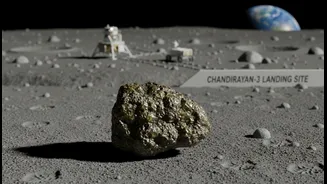
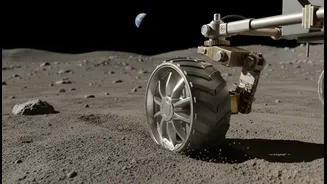
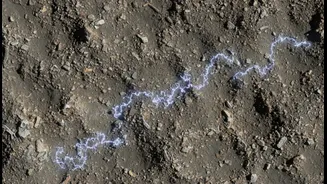
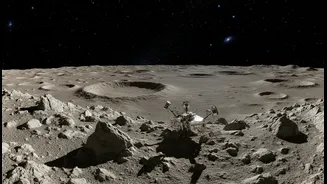
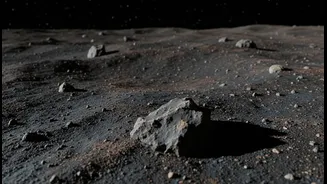
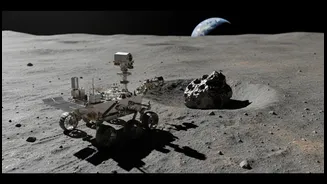
Enter Chandrayaan-3. After its historic landing near the lunar south pole in 2023, the Pragyan rover began analyzing its surroundings at the 'Shiv Shakti' landing site. Onboard the rover, instruments like the Alpha Particle X-ray Spectrometer (APXS) and the Laser-Induced Breakdown Spectroscope (LIBS) went to work. These tools analyze the chemical makeup of the lunar soil, or regolith. The LIBS instrument, for instance, fires a high-energy laser at the soil, creating a tiny, superheated plasma. By analyzing the light from this plasma, scientists can determine the elements present. The analysis revealed the expected elements like aluminum, iron, and silicon, but also confirmed the presence of sulphur, a finding that was not feasible with orbiters. More importantly, the data showed the soil at Shiv Shakti had a unique chemical signature: it was lower in aluminum but richer in iron and magnesium compared to typical lunar highlands.
The Crucial 'Match'
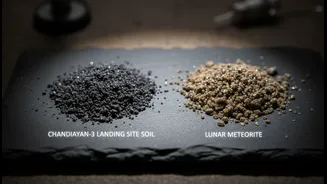
Scientists at the Physical Research Laboratory (PRL) in Ahmedabad took this new data from Chandrayaan-3 and began a comparison. They cross-referenced the chemical composition of the Shiv Shakti soil with data from 66 known lunar meteorites found on Earth. The result was a stunning connection. Among all the candidates, the meteorite ALHA 81005—the first-ever confirmed lunar meteorite—was the closest geochemical match. The proportions of key compounds were remarkably similar. For example, the landing site soil contained about 26.1% aluminum oxide, while the meteorite had 25.8%. The combined iron and magnesium oxide levels were also closely aligned, at 14.4% for the rover's sample and 13.7% for the meteorite. This strong chemical resemblance strongly indicates that the ALHA 81005 meteorite represents the same type of crustal material found by Chandrayaan-3 in the Moon's south polar region.
Why Not the 'Exact Source'?
The headline is precise for a reason. Finding a chemical match means both the soil at Shiv Shakti and the meteorite ALHA 81005 likely originated from the same type of geological terrain—a magnesium-rich part of the lunar crust. However, ISRO scientists clarify that this does not mean the meteorite was physically launched from the exact spot where the Pragyan rover took its measurements. Pinpointing the specific crater from which a meteorite was ejected millions of years ago is incredibly difficult, if not impossible. Think of it as knowing a package came from a particular city, but not knowing the specific street or house number. The match is regional, not a precise point of origin. The finding suggests that the south polar region has a distinct composition and that we now have samples of it on Earth to study, thanks to this meteorite.
A New Chapter in Lunar Science
This discovery is a major step forward for lunar science and a significant achievement for the Chandrayaan-3 mission. It effectively gives geologists a 'ground truth' link between a region explored by a rover and a rock sample they can hold in a lab on Earth. The analysis also suggests the soil at the landing site is a complex mix, containing material from both the upper crust and deeper, magnesium-rich layers, likely excavated by a massive, ancient impact event like the one that formed the South Pole-Aitken basin. By connecting the dots between in-situ measurements on the Moon and meteorite analysis on Earth, ISRO has opened a new avenue for understanding how the Moon's ancient crust was formed and has evolved over billions of years.