






The Great Arctic Cloud Mystery
The Arctic climate system is a finely balanced machine, and clouds play a critical, yet confounding, role. They can act as a shield, reflecting sunlight back into space and cooling the surface, or as a blanket, trapping heat and warming it. This dual
nature makes them one of the biggest sources of uncertainty in global climate models, which struggle to accurately simulate their behavior. Getting it right is crucial because the Arctic is warming at a rate two to four times the global average, a phenomenon known as Arctic amplification. Understanding every factor, especially the most unpredictable ones like clouds, is essential for forecasting the region's future and its impact on the rest of the planet.
A Breakthrough at the Ice's Edge
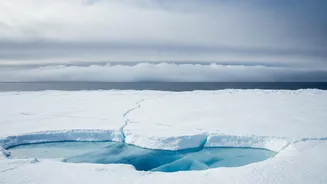
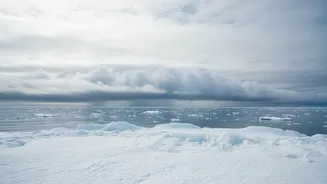
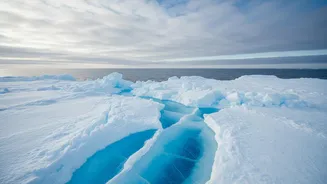
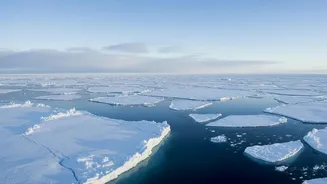
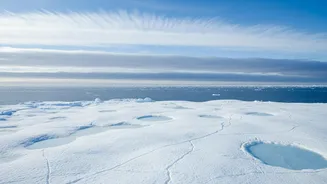
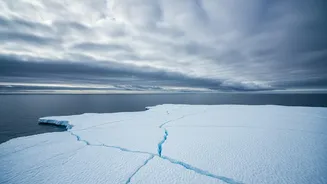
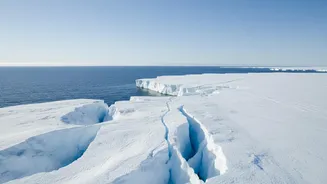
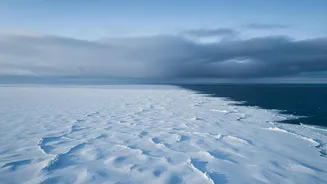
An international team of scientists has provided a crucial piece of this puzzle. Their research, published in early August 2026, details a previously unknown natural process that dramatically increases the number of cloud-forming particles in the Arctic air. The study focused on the marginal ice zone—the dynamic boundary where open ocean meets melting sea ice. Here, researchers discovered that a combination of biological activity from marine algae, chemical compounds like iodine released from the ocean, and sunlight triggers a massive creation of new atmospheric particles. These tiny particles, called aerosols, are the essential seeds around which water vapor can condense to form cloud droplets.
From Ocean Life to Sky-Seeding
The process begins when melting ice exposes the ocean to more sunlight. This fuels a bloom in marine life, particularly algae, at the ice's edge. This explosion of life, combined with compounds from the water and ice, releases a potent chemical mixture into the air, including iodine and sulphur compounds. When sunlight hits this mixture, it sparks a chemical reaction known as new particle formation. The team observed this process creating a fifty-fold increase in the number of potential cloud-seeding particles in a single day. Critically, they also identified a new class of iodine-containing organic molecules that help these tiny newborn particles grow large enough to actually influence cloud formation, a key step that had previously only been demonstrated in lab settings.
Refining the Global Climate Picture
This discovery has significant implications for climate models. For years, scientists knew that something in the Arctic was creating more cloud-forming particles than their models predicted, but the source was a mystery. This study provides a powerful, real-world validation of a major natural source linked directly to melting sea ice. As the Arctic continues to warm and more sea ice retreats each summer, this marginal ice zone expands, meaning this cloud-seeding process is likely becoming more frequent and intense. Incorporating this new, biologically driven mechanism into climate models will help make them more precise, reducing one of the key uncertainties in their projections. This doesn't necessarily change the overall picture of warming, but it helps refine the details of how, where, and how quickly those changes will manifest.
A More Complex, Connected Climate
The findings underscore the intricate connections between the ocean, ice, atmosphere, and life itself. It shows that microscopic organisms in the Arctic Ocean can have a large-scale impact on the atmosphere and, by extension, the entire climate system. However, the net effect of these extra clouds is complicated. More clouds in the summer could reflect more sunlight, potentially cooling the open ocean. Conversely, more clouds in the autumn and winter could trap heat, slowing the refreezing of sea ice. Understanding this newly discovered feedback loop—where melting ice leads to more particles, which leads to more clouds that can in turn affect the ice—is the next critical step for scientists working to create a clearer picture of our planet's future.