





Examine the Weave for 'Perfect Imperfections'
A handloom saree is woven by a skilled artisan, and this human touch is its signature. Look closely at the fabric. You'll notice minor, subtle irregularities in the weave—a slightly thicker thread here, a tiny knot there, or gentle inconsistencies in spacing.
These are not defects; they are the hallmarks of craftsmanship that give the saree its unique character. A power-loom saree, by contrast, is mechanically produced, resulting in a flawless, uniform, and machine-perfect texture that can feel flat and lifeless. If a saree looks too perfect, it probably is machine-made.
Flip it Over: The Reverse Side Tells a Story
One of the most reliable tests is to check the reverse side of the saree, especially behind the motifs and borders. On a handloom saree, the back of the woven designs may show visible threads or natural, neat joins where the weaver has worked the pattern into the fabric. In some intricate weaves like the Korvai technique, you might even feel a faint, raised ridge where the border is interlocked with the body. A power-loom saree's reverse side will often look unnaturally clean and uniform, sometimes almost identical to the front, which is a clear sign of machine production.
Feel the Fabric, Drape, and Texture
Authentic handloom Kasavu is typically made from high-quality cotton that feels soft and breathable. Handwoven fabrics tend to be more resilient and soften beautifully with each wash. When draped, a handloom saree has a graceful fall that holds its shape. A power-loom saree, even if made with cotton, often feels stiffer and less breathable due to the high tension used in machine weaving. Gather a section of the saree in your hand; a handloom piece will feel supple and natural, while a power-loom one might feel more rigid or have a synthetic-like smoothness.
Look for Pin Marks on the Selvedge
A classic sign of an authentic handloom saree is the presence of tiny pin marks or holes along the selvedge (the finished edge). Weavers pin the saree to the loom to keep the fabric taut during the weaving process, which leaves these small but significant marks. These are usually found at regular intervals along the top or bottom edge. Power-loom machines use different mechanisms that result in perfectly smooth, machine-finished edges without any such pinholes. Spotting these marks is a strong indicator that you're holding a genuine handwoven piece.
Consider the Zari and Finish
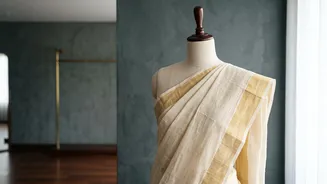
The 'Kasavu' itself refers to the golden zari border that defines the saree. In a handloom saree, the zari is carefully woven into the fabric and should have a subtle, elegant sheen rather than an overly glossy or plastic-like shine which is common in low-quality machine-made versions. The overall finish of a handloom saree embraces its handcrafted nature—the pallu might end with extra threads that can be made into tassels, and the borders might have a soft, slightly uneven feel. Power-loom sarees, aiming for mass production, have mechanically perfect and straight edges.
The Price and the Story
Handloom weaving is a slow, labour-intensive art form. A single saree can take days or even weeks to complete. This dedication, skill, and time are reflected in the price. If a saree with seemingly intricate work is being sold at a very low price, it is almost certainly a power-loom product. Authentic handloom sarees are an investment in heritage and craftsmanship. Reputable sellers will also be able to tell you about the weaving cluster where the saree was made, such as Kuthampully or Balaramapuram, further cementing its authenticity.