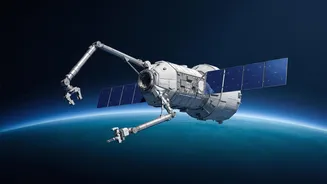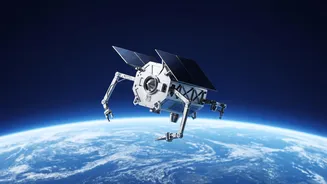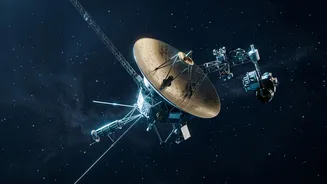








Have you ever wanted to name a spaceship? The UK Space Agency is offering the public a chance to make history by naming its very first national space mission, a pioneering effort to clean up the increasingly crowded environment of Earth's orbit.
Britain’s Orbital Janitor
This isn't
a mission to Mars or a voyage to the outer planets, but it's one of the most critical space endeavours of our time. The spacecraft you could name is an Active Debris Removal (ADR) mission. In simple terms, it’s a cosmic clean-up crew. The mission's goal is to capture two defunct satellites currently orbiting Earth and guide them to safely burn up in the atmosphere. With nearly 13,000 active satellites and tens of thousands more expected by 2030, the space around our planet is becoming a hazardous junk-yard. This debris poses a significant threat to the operational satellites we rely on for everything from GPS and weather forecasting to communications and banking. Developed by ClearSpace UK, the spacecraft will use advanced British robotics and navigation technology to perform its unprecedented task. The mission represents a major step for the UK in leading the charge for space sustainability.
A Milestone for the UK in Space
While Britain has a long history of space involvement, including launching its first satellite 'Ariel 1' in 1962 and putting the 'Prospero' satellite into orbit with a British 'Black Arrow' rocket in 1971, this is being hailed as the UK's 'first national mission'. The distinction highlights the country's renewed focus on building sovereign capabilities. Backed by a significant government investment, the mission is designed to demonstrate UK leadership in the growing field of in-orbit services and space sustainability. By developing the technology to remove debris, the UK not only helps protect vital global infrastructure but also positions its space sector as a key player in the future of space operations. This move is part of a broader national strategy to grow the UK's space economy and ensure it can protect its interests in and through space.
The ‘Boaty McBoatface’ Effect
Of course, whenever a public naming contest is announced, one name comes to mind: 'Boaty McBoatface'. The 2016 campaign to name a polar research ship famously saw the playful moniker win the public vote by a landslide, only for officials to name the vessel after Sir David Attenborough. The name, however, lived on, being given to one of the ship's submersibles. The internet is already buzzing with similarly witty suggestions for the debris-removal craft, with names like 'Obi Wan Cleanobi', 'Mega Maid' (from the film 'Spaceballs'), and references to British cleaning icons like the 'Wombles' and 'Henry' the vacuum cleaner gaining traction online. While some see it as trolling, these campaigns ignite public conversation about science and exploration in a way that formal announcements rarely do. The UK Space Agency seems prepared, having set clear rules for the competition.
How to Leave Your Mark on History
If you think you have a better idea than 'Debris McGee', here is your chance. The UK Space Agency is accepting submissions until Thursday, December 10, 2026. The competition is open to all UK residents, with entries on behalf of children, schools, or community groups strongly encouraged. The rules are straightforward: the proposed name must be a maximum of two words and should be submitted with a short explanation of no more than 150 words detailing how it reflects the mission's theme of keeping space clean and safe. The name should be easy to pronounce, work internationally, and avoid political or commercial themes. The grand prize is more than just bragging rights; the winning name will be etched onto the side of the spacecraft and featured on the official mission patch, literally sending your idea into the history books.