



A Glimpse Into the Future
On a timescale almost too vast to comprehend, the ground beneath our feet is in constant motion. Driven by the slow grind of tectonic plates, Earth’s continents are expected to collide once again, roughly 250 million years from now. Scientists have dubbed
this potential future supercontinent 'Pangea Ultima'. It would be the successor to the last supercontinent, Pangea, which broke apart around 200 million years ago. Projections suggest Pangea Ultima will form as the Atlantic Ocean closes, fusing the Americas with a combined Afro-Eurasian landmass. While the exact shape is a matter of scientific debate, with other models like Amasia also proposed, the formation of a single, giant continent would fundamentally rewire our planet's climate systems.
The Unlivable Greenhouse
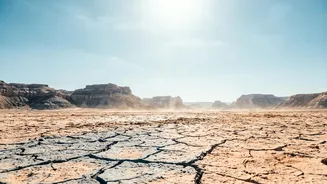
A groundbreaking study published in Nature Geoscience used supercomputer simulations to model the climate of Pangea Ultima, and the findings are startling. The research suggests that the supercontinent would be overwhelmingly hostile to mammal life, including humans. The models predict that widespread land temperatures could soar to between 40 and 50 degrees Celsius (104 to 122 degrees Fahrenheit). In the planet's warmest months, daily extremes could be even higher, with some simulations showing averages up to 70°C (158°F). In such a scenario, only a small fraction of the land, perhaps as little as 8%, would remain habitable for most mammals. The vast, arid interior would essentially become a planet-sized desert, devoid of the food and water sources necessary for survival.
The Science of Extreme Heat
The extreme climate of Pangea Ultima isn't caused by a single factor, but a powerful combination of three key elements. Lead researcher Dr. Alexander Farnsworth described it as a 'triple whammy'. First is the 'continentality effect': large landmasses have more extreme climates because vast interior regions are far from the moderating influence of oceans. Second, the Sun itself is gradually getting brighter, and in 250 million years, it is expected to emit about 2.5% more radiation, further heating the Earth. The third factor is a dramatic increase in atmospheric carbon dioxide. The tectonic collision and resulting volcanic activity would release massive amounts of CO2, potentially doubling it from today's levels and intensifying the greenhouse effect. This combination creates a feedback loop of escalating heat.
A World Without Us?
For mammals, the key challenge is not just the heat, but the humidity. While mammals have evolved to survive cold, our ability to withstand extreme heat is limited. We cool ourselves by sweating, but this mechanism becomes ineffective in conditions of extreme heat and high humidity, which would plague the coastal regions of the supercontinent. The inability to shed body heat would be lethal. While life itself would not be extinguished—reptiles, for example, may be better adapted to thrive—the dominant era of mammals could come to a fiery end. Researchers suggest that any surviving mammals might be forced into small, habitable pockets near the poles or adopt nocturnal lifestyles to avoid the worst of the day's heat. But for the most part, the world would belong to species with a much higher heat tolerance.
Lessons From a Distant Future
Why should we care about a speculative catastrophe 250 million years from now? The Pangea Ultima research is not a doomsday prophecy for our time, but a powerful illustration of the forces that govern Earth's habitability. It underscores how deeply intertwined geology and climate are. The study provides a unique natural experiment, showing how planetary systems can be pushed past a tipping point. It demonstrates that even a planet within the 'habitable zone' of its star is not guaranteed to be hospitable; its continental configuration and atmospheric composition are critically important. The researchers are careful to note that their model does not include human-caused carbon emissions, which are warming the planet on a much faster timescale. However, by studying these deep-future scenarios, we gain a more profound understanding of the delicate balance that makes our present-day Earth so uniquely suited for life.