



The Case of the Empty Nursery
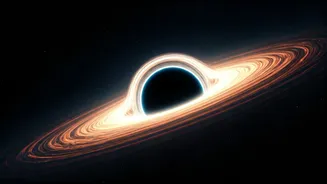
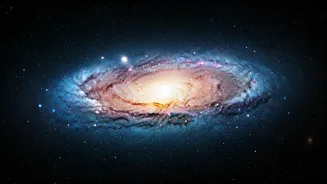
Imagine the center of a bustling city, a place you'd expect to be teeming with activity. For astronomers, the center of our Milky Way galaxy is just that—a dense, turbulent region around a supermassive black hole called Sagittarius A. This area, known
as the Central Molecular Zone (CMZ), is packed with vast clouds of gas and dust, the essential ingredients for making new stars. Logically, it should be one of the most productive stellar nurseries in the entire galaxy. However, recent studies have revealed something perplexing: the star formation rate is much lower than predicted. In fact, some areas appear to be strangely devoid of the young, bright stars that scientists expected to see, creating what some have called a 'stellar desert'. This discrepancy between the abundance of raw material and the lack of new stars presents a major cosmic puzzle.
A Paradox of Youth
The mystery deepens when you look even closer to the central black hole. In its immediate vicinity, an environment so hostile that its immense gravitational forces should tear apart any fragile, collapsing gas clouds, astronomers have found a cluster of very young stars. This finding, dubbed the 'paradox of youth,' has baffled scientists for years. How could stars possibly form in a place that seems designed to prevent their birth? The presence of these young stellar objects (YSOs) so close to Sagittarius A, alongside the puzzling lack of star formation in the wider, gas-rich regions slightly farther out, suggests our understanding of galactic dynamics is incomplete. It’s as if the galaxy’s star-making factory is shut down in the main production hall but is somehow running in a tiny, prohibitively dangerous side room.
Searching for Cosmic Culprits
So, where has all the star formation gone? Astronomers are exploring several theories. One leading hypothesis points to powerful magnetic fields. Recent observations have revealed long filaments of hot gas threaded through the galactic center, suggesting that strong magnetic forces may be acting as a kind of cosmic bubble wrap. These fields could be preventing the dense gas clouds from collapsing under their own gravity, effectively putting the brakes on star formation. Another possibility involves the sheer turbulence of the region. The gas clouds might be moving too violently, stirred up by past stellar explosions (supernovae) and the black hole's influence, preventing them from settling down and forming stable cores that can grow into stars. A third idea is that star formation in the galactic center isn't continuous but happens in dramatic bursts. Evidence suggests there was a massive wave of star birth about one billion years ago, followed by a long quiet period. We might simply be observing the galaxy during a lull in its star-making activity.
Peering Through the Dust
Unraveling this mystery has only been possible thanks to cutting-edge technology. The galactic center is shrouded in thick clouds of cosmic dust, making it invisible to telescopes that see in visible light. Astronomers must rely on instruments that can detect infrared and X-ray radiation, which can penetrate this veil. The James Webb Space Telescope (JWST), with its unparalleled infrared sensitivity, has provided breathtaking new views of this region, called Sagittarius C. These images have revealed never-before-seen features and a staggering density of stars—an estimated 500,000 in one small section alone. By studying the light from these stars and the gas surrounding them, scientists can piece together clues about the temperature, density, and movement of material at the galaxy's heart, helping to test their theories about the missing stellar activity.