


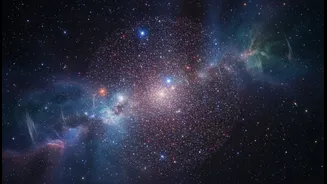
A Cosmic Tipping Point
Astronomers believe they have uncovered a dramatic event from our galaxy's distant past: a head-on collision with a smaller, yet still massive, dwarf galaxy. This cataclysmic encounter, which occurred roughly 10 billion years ago, was so powerful that
it may have tipped the entire disc of the Milky Way by more than 90 degrees. The findings, presented by researchers from Durham University, suggest that the tranquil spiral we see today is a survivor of a much more chaotic youth. This flip wasn't instantaneous, but a gradual reorientation that likely unfolded over hundreds of millions of years, permanently altering our galaxy's place in the cosmos.
The Prime Suspect: A 'Sausage' Galaxy
The culprit in this cosmic drama is a dwarf galaxy known to astronomers as Gaia-Sausage-Enceladus, or simply the 'Gaia Sausage'. This name comes from the distinctive, sausage-like shape of the orbits of stars left behind after the collision. First identified in 2018 using data from the European Space Agency's Gaia mission, this merger is now considered the last major collision in the Milky Way's history. Although it was a dwarf galaxy, the Gaia Sausage was substantial, containing stars, gas, and dark matter amounting to more than 10 billion times the mass of our sun. As it plunged into the young Milky Way, it was torn to shreds, its stars scattered throughout our galaxy's halo.
The Evidence in the Stars
The key clue that led to this discovery is a long-standing astronomical mystery: the surprisingly slow rotation of our galaxy's stellar halo. The stellar halo is a vast, sparse sphere of stars surrounding the main galactic disc. While stars in the disc, like our sun, orbit the galactic center at a brisk 220 kilometers per second, stars in the halo creep along at a much more leisurely 25 kilometers per second. Researchers used supercomputer simulations to model how galaxies like ours evolve. They found that galaxies with slow-rotating halos were very likely to have experienced two things: a major head-on collision and a dramatic 'disc flip'. The Gaia Sausage collision perfectly fits the bill.
A New Chapter in Our History
This discovery doesn't just solve a puzzle; it rewrites a fundamental chapter of our galaxy's biography. The collision didn't just scatter stars; it profoundly reshaped the Milky Way, helping to form the central bulge and dominating the stellar halo we see today. The idea that our entire galactic disc was reoriented means that most of its stars, possibly even our own Sun, once travelled on very different paths. It adds a new layer of dynamism to our understanding of galactic formation, showing that galaxies are not static structures but are constantly evolving through violent mergers and interactions. This violent event helped build the Milky Way into the galaxy it is today.