







Cosmic Engines and Their Smaller Cousins
Across the universe, astronomers have observed blazars, which are among the most powerful objects known. They occur when a supermassive black hole, millions or billions of times the mass of our sun, sits at the center of a galaxy, feeding on surrounding
gas and dust. This process unleashes colossal jets of particles that travel at nearly the speed of light. When one of these jets happens to point directly at Earth, we see it as a blazar—an incredibly bright and energetic beacon. Scientists have long theorized that a smaller version, a 'microblazar', should also exist. Instead of a supermassive black hole, a microblazar would be powered by a stellar-mass black hole, perhaps just 10 times the mass of our sun, siphoning material from a companion star in a binary system. Finding one has been a long-standing challenge, as the phase of evolution where a system acts like a microquasar is very short.
A Signal from 12,000 Light-Years Away
The breakthrough discovery centers on a system named IRAS 18293-0941, located about 12,000 light-years away within our Milky Way galaxy. An international team of researchers noticed that the system, which consists of a black hole orbiting a massive companion star every 11 days, was emitting a powerful, one-sided jet of plasma. This jet is traveling at a staggering 75% of the speed of light. For decades, the object was cataloged but largely overlooked because it was hidden behind a thick veil of interstellar dust, making it essentially invisible in normal optical light. However, using a combination of radio and gamma-ray observatories, scientists were able to piece together the puzzle.
Connecting the Dots Across the Cosmos
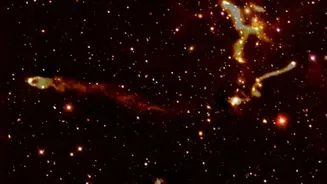
What makes this object a strong microblazar candidate is the orientation of its jet. It appears to be pointed almost directly at Earth. This alignment causes an effect known as relativistic beaming, which makes the jet appear significantly brighter to us than it would otherwise. It’s like looking directly into the beam of a flashlight; the orientation, not just the bulb's power, determines the intensity. Further evidence came from radio observations that revealed the jet's impact on its surroundings. While the jet aimed at Earth is bright, astronomers could also see the effects of the opposing jet, which is pointed away from us. This second jet is carving out a vast structure in the interstellar medium that extends for about 100 light-years. The interaction also appears to be creating extremely high-energy gamma rays.
A New Cosmic Laboratory
If confirmed, IRAS 18293-0941 would be the first microblazar identified in our own galaxy, offering an unprecedented opportunity for study. Because it is relatively close, it can serve as a 'cosmic laboratory' for understanding the physics of these extreme systems. Blazars are too distant to be studied in such detail, but a local version could reveal how black holes launch these powerful jets and pour energy into their surroundings. Furthermore, the interaction between the jet and a nearby molecular cloud seems to be accelerating particles to energies 100 times greater than what can be achieved at the Large Hadron Collider, Earth’s most powerful particle accelerator. This could help solve long-standing mysteries about the origin of some of the most energetic cosmic rays in our galaxy.