





A Long-Held Cosmic Theory
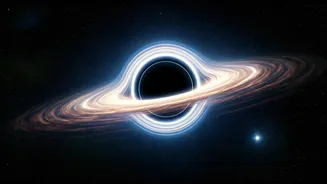
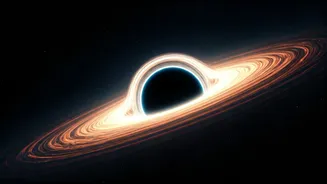
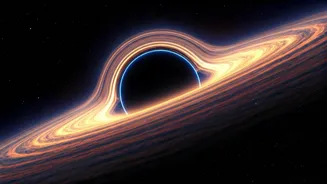
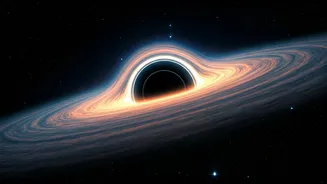
At the very center of our galaxy, about 27,000 light-years from Earth, lurks Sagittarius A (Sgr A), a supermassive black hole with the mass of over four million suns. For nearly 50 years, astrophysicists have worked off a fundamental theory: the immense
gravity of such a black hole should gather a dense swarm of old stars around it. This cluster, known as a 'stellar cusp', was predicted to grow increasingly dense the closer you got to the black hole's event horizon. This idea, born from foundational work by physicists Bahcall and Wolf in the 1970s, became a core assumption in understanding galactic centers. It made logical sense—the black hole's gravity would capture stars over billions of years, pulling them into a tight, gravitationally-bound huddle.
A Hole Where Stars Should Be
The problem is, when astronomers developed powerful enough tools to look, the evidence was shaky. As early as 2009, observations began to hint that something was amiss. Instead of a dense spike of stars, there appeared to be a 'hole' or a flat core in the stellar population right around Sgr A. This created a major puzzle for astronomers, often called the 'conundrum of old age'. The theory was robust, but reality wasn't matching up. Was there an issue with the observations, or a fundamental flaw in the theory? Distinguishing between the different types of stars in this incredibly crowded region was a monumental challenge, leaving the question open for years.
A New, Sharper Look at the Center
Enter the GRAVITY instrument at the European Southern Observatory's Very Large Telescope (VLT) in Chile. This powerful tool uses a technique called interferometry, which combines the light from all four of the VLT's 8.2-metre telescopes to create a 'virtual telescope' up to 130 meters in diameter. This gives it astonishingly sharp vision, capable of making incredibly precise measurements of the positions and movements of stars. A recent study leveraged GRAVITY's power, along with other advanced instruments, to conduct the most detailed survey yet of the faint stars whipping around Sgr A. By carefully tracking their motions, astronomers could finally get a clear, unambiguous picture of the stellar distribution, separating old stars from younger interlopers.
The Verdict: No Cusp
The latest findings are definitive: the long-predicted stellar cusp of old stars does not exist. Instead of finding a dense cluster, the new study confirms the 'hole' around the black hole, finding a lack of stars in the very region where theory predicted they should be most concentrated. This effectively rules out the classical model of a relaxed stellar cusp at the galactic center. This is a significant moment in astrophysics, forcing a rethink of how supermassive black holes and their star-filled environments interact over cosmic timescales. It transforms a long-standing paradox into a confirmed anomaly that now requires a new explanation.
So, What's There Instead?
If not a dense pack of old stars, what occupies the space around Sgr A*? The absence of these stars suggests the mass must be composed of something much harder to see. The leading hypothesis now is that this region is populated by a dense cluster of stellar remnants—a graveyard of objects like smaller, stellar-mass black holes, neutron stars, and white dwarfs. Previous simulations have suggested that thousands of stellar-mass black holes could have migrated to the galactic center over time. These dark objects would contribute to the mass of the central cluster without being easily visible, explaining why observations failed to find the expected number of luminous stars. The mystery of the missing cusp may have been solved by replacing it with a far darker, more invisible population.