


A New Window on Our Star
Scientists have released the highest-resolution image ever taken of the Sun's surface in visible light, providing an unprecedented look at the fiery plasma that makes up our star. The breathtaking images come from the Daniel K. Inouye Solar Telescope
in Hawaii, the most powerful solar telescope in the world. Operated by the U.S. National Science Foundation (NSF), this facility allows researchers to see features on the sun as small as 20-30 kilometres across—akin to identifying a coin from 180 kilometres away. While the NSF operates the telescope, NASA is a key partner, with its scientists playing a crucial role in analyzing the data to better understand solar physics. This new image, captured in early August 2026, marks a giant leap forward in our ability to study the Sun in stunning detail.
Peering into the Fiery Chaos
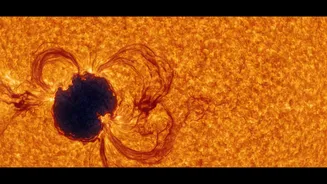
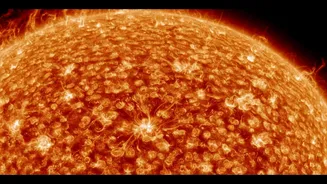
So, what exactly are we seeing? The image reveals the Sun's photosphere, its visible surface, covered in a pattern of boiling, turbulent plasma. This includes cell-like structures known as granules, each roughly the size of Texas, which are the tops of convection cells that carry heat from the Sun's interior. But the latest images go further, uncovering something long theorized but never directly observed: tiny plasma whirlpools created by a phenomenon called the Kelvin-Helmholtz instability. This occurs when fluids—or in this case, streams of solar plasma—move past each other at different speeds, creating a shear force that spins up into vortexes. These newly seen swirls and ultrafine magnetic 'stripes' cluster at the edges of the granules, revealing a dynamic and violent reality on a scale previously invisible to us.
More Than Just a Pretty Picture
These discoveries are more than just cosmic sightseeing; they are fundamental to solving some of the biggest mysteries in solar physics. For decades, scientists have puzzled over why the Sun's outer atmosphere, the corona, is millions of degrees hotter than its surface. The newly observed plasma vortices may hold the key. Researchers theorize that these instabilities could play a role in transporting energy from the surface up into the corona, heating it to its extreme temperatures. By studying how these tiny whirlpools move energy and magnetic fields around, scientists can build more accurate models of how the Sun works. This detailed view of the Sun's magnetic architecture is critical for understanding everything from its 11-year cycle to its most violent outbursts.
Predicting the Sun's Temperament
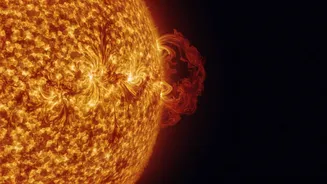
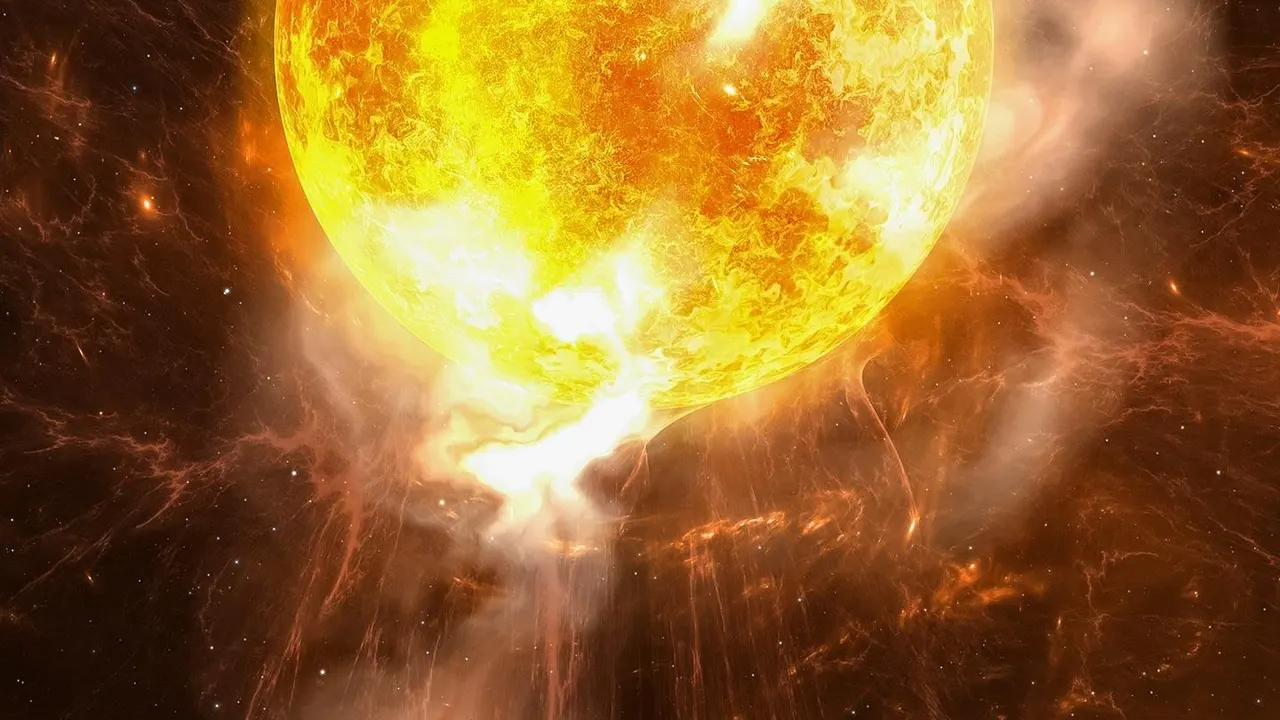
Understanding the Sun’s behaviour has direct implications for life on Earth. The same magnetic forces creating these intricate patterns can also power solar flares and coronal mass ejections (CMEs)—massive eruptions that hurl charged particles into space. This activity, known as space weather, can disrupt satellites, cripple communication networks, and even bring down power grids. By observing the very 'roots' of this activity on the solar surface with such clarity, scientists hope to dramatically improve their ability to forecast space weather. Being able to predict when and where these powerful solar storms might erupt is a primary goal of solar physics, and the Inouye Solar Telescope's unprecedented resolution gives us a powerful new tool in that effort, helping to protect our increasingly technology-dependent world.