






The Galaxy's Quiet Giant
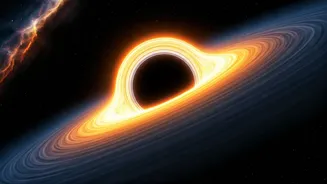
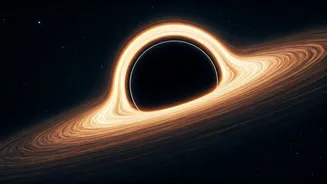
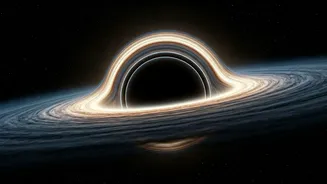
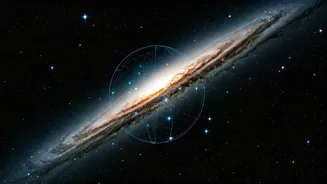
Sagittarius A, or Sgr A for short, is the gravitational anchor of our galaxy, located about 27,000 light-years from Earth. For years, it has puzzled astronomers. Compared to the supermassive black holes in other galaxies, which can be incredibly bright
and active as they devour surrounding matter, Sgr A is surprisingly quiet. While it's known to have flares and burps of activity, its overall energy output is much lower than expected given the amount of gas and dust available for it to consume. This has led to a long-standing question: what is putting our galaxy's black hole on a diet?
A Cosmic Magnifying Glass in Chile
Enter the Atacama Large Millimeter/submillimeter Array, better known as ALMA. Perched high in the Chilean Andes, this array of 66 high-precision antennas works together as a single, powerful radio telescope. ALMA is uniquely suited to peer into the dense, dusty core of the Milky Way, observing the faint radio waves emitted by cold gas that are invisible to optical telescopes. By creating incredibly detailed maps of this gas, astronomers can trace its motion and structure, looking for clues about the forces at play near the black hole's edge.
An Invisible Wind
Recent findings from ALMA have provided the clearest evidence yet of a powerful outflow, or 'wind,' being driven away from Sgr A. For decades, scientists predicted that as black holes feed on gas, they should also expel a portion of that material. After years of observations, researchers were able to create the most sensitive map ever of the cold gas near the black hole. By subtracting the bright radio glow of Sgr A itself, they uncovered a giant, cone-shaped cavity in the surrounding gas. This void is a clear signature of something pushing material outward from the black hole's vicinity. The discovery confirms that black holes aren't just cosmic vacuum cleaners; they also actively shape their galactic environments.
The Role of Magnetic Fields
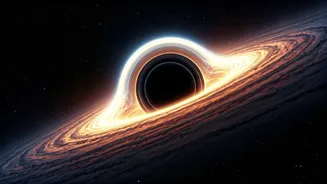
So, what's powering this wind? The clues point to strong and highly organized magnetic fields spiraling around the edge of the black hole. Data gathered by the Event Horizon Telescope, which includes ALMA, revealed a magnetic field structure around Sgr A that is strikingly similar to the one around M87's much larger and more active black hole. These powerful magnetic fields can act like a cosmic slingshot. As gas and dust spiral inward in what's called an accretion disk, the fields can trap some of the material and launch it outward at incredible speeds, forming a wind or even a jet. This process may be preventing a large amount of matter from ever reaching the black hole, explaining its relative quietness.
From Clues to a Clearer Picture
While these discoveries are a major leap forward, they are still just one part of a larger puzzle. The detection of this wind confirms a long-held theory and provides a compelling explanation for Sgr A's gentle nature. Astronomers now have strong evidence that even though our galaxy's black hole isn't launching a massive, visible jet like M87's, it is still powerfully influencing its surroundings through these magnetic winds. Future observations with ALMA and the Event Horizon Telescope will continue to refine this picture, helping scientists understand not just our own galactic center, but the complex relationship between supermassive black holes and the galaxies they inhabit across the universe.