






The Tell-Tale Heart
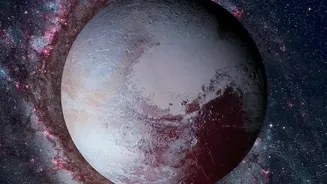
The clue comes from Pluto's most famous feature: a vast, heart-shaped basin of nitrogen ice called Sputnik Planitia. Using images from the New Horizons spacecraft, which flew past the dwarf planet in 2015, scientists spotted a network of strange dark
streaks and patches along the northern edge of this massive glacier. After extensive analysis, a team led by researchers at the Southwest Research Institute has proposed a stunning explanation. They believe these features are evidence of liquid nitrogen that has recently welled up from beneath the ice and flowed across the surface before freezing again.
A Subsurface Surprise
This isn't like rain on Earth. Pluto's thin atmosphere and extreme cold make liquid nitrogen rain physically impossible. Instead, computer models suggest a different process is at play. Sputnik Planitia is a glacier several kilometres deep, composed primarily of nitrogen ice. The immense pressure at the bottom of this ice sheet, possibly combined with faint heat from Pluto's interior, could be enough to melt the nitrogen at its base, creating a subsurface liquid layer. This buoyant liquid nitrogen would then be forced upward through cracks and fissures in the ice, similar to how magma rises through Earth's crust.
Finding a Familiar Pattern
To strengthen their case, scientists turned to a more familiar icy landscape: Greenland. Researchers compared the New Horizons images of Pluto's dark streaks to satellite photos of Greenland's ice sheet. They found a striking similarity. On Earth, similar dark patterns are created when meltwater seeps up and temporarily wets the surface of snow and ice. The visual match between the features on two different worlds—one water-based and one nitrogen-based—provides compelling support for the idea that a liquid process is responsible for the marks on Pluto.
A World More Alive Than We Imagined
This discovery fundamentally changes our view of Pluto. It suggests the dwarf planet is not a static, frozen ball of ice but a geologically active world where complex processes are still shaping the surface today, or at least in the very recent geological past. The surface of Sputnik Planitia is thought to be less than a million years old, constantly renewed by the slow churning of convection cells in the ice. The evidence of flowing liquid adds another layer of activity, hinting that Pluto may host dynamic, time-variable features we have yet to fully understand. As New Horizons Principal Investigator Alan Stern noted, "Pluto never stops surprising us."