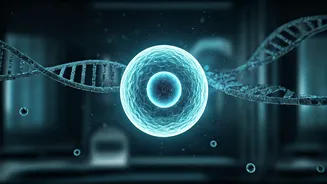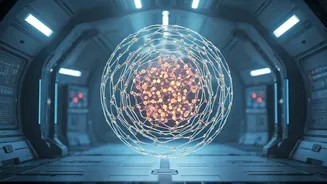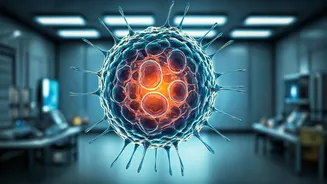







What is a Synthetic Cell?
For decades, the holy grail of synthetic biology has been to build a cell from the ground up. This isn't about modifying an existing living organism, but rather assembling a new one from a list of chemical ingredients. Think of it as the difference between
renovating a house and building a new one from a pile of bricks and timber. Previous breakthroughs, like those by the J. Craig Venter Institute, took a 'top-down' approach, stripping down the genetic code of existing bacteria to find the minimum requirements for life. The SpudCell project, however, is a 'bottom-up' achievement. Researchers started with a chemical soup and watched as life-like behaviors emerged, giving them complete knowledge of every component involved.
Meet SpudCell: The 'Potato' Cell
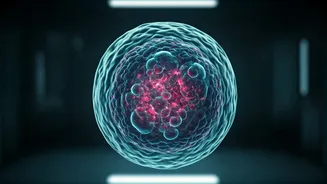
Led by researchers Kate Adamala and Aaron Engelhart at the University of Minnesota, the project has created what many are calling a landmark in biology. These tiny structures, assembled from lipids, proteins, and a synthetic genome, can feed on nutrients in their environment, grow larger, replicate their DNA, and divide to create a new generation. The name 'SpudCell' is a playful nod to several things: the cell’s lumpy, potato-like appearance; a tribute to the satellite Sputnik, heralding a new era; and a joke from Polish-born Adamala, who quipped, “I'm mostly made of potatoes.” But its function is anything but a joke. These are considered the first synthetic cells to demonstrate a complete life cycle, a feat that has eluded scientists until now.
How Does It Work?
The process began by mixing a cocktail of non-living chemical components—including DNA, proteins, and other molecules—in a solution. Fatty molecules called lipids were added, which naturally formed bubble-like membranes, trapping the other ingredients inside. In some of these bubbles, the right combination of parts was captured to kickstart a cascade of activity. Fed by a liquid medium brimming with vital chemicals, the SpudCells absorb resources, grow, and eventually split. Unlike natural cells, which use a complex internal scaffolding to divide, the SpudCell divides through a simpler process involving mechanical stress on its membrane, sidestepping a major hurdle in synthetic cell research.
Is It Truly Alive?
This is the big question, and the answer is complicated. SpudCell shows many hallmarks of life, including growth, replication, and even a form of evolution. In one experiment, the team engineered a version that was better at acquiring food and watched as it out-competed the original version over five generations. However, the cell is still primitive. It is completely dependent on the nutrient-rich 'soup' it lives in and cannot produce many of its own essential components. It also peters out after a few generations. Adamala herself has been careful not to definitively call it 'alive', noting that the line between complex chemistry and biology is becoming increasingly blurry.
The Dawn of the Bioeconomy
The long-term vision for SpudCell extends far beyond the lab. The researchers see it as the foundation for a new 'bioeconomy'. Because these cells are built from scratch, scientists know their exact composition, making them fully programmable. This could lead to engineered cells that act as miniature factories, designed to produce medicines, sustainable fuels, or advanced materials with incredible precision and lower energy costs compared to current industrial chemistry. To accelerate this future, Adamala and her collaborators are launching a public-benefit institution called Biotic to share the SpudCell 'chassis' and foster global collaboration, rather than patenting the technology for private gain.