



Meet NASA's New Cosmic Surveyor
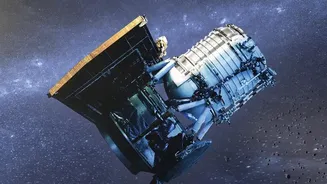
The Nancy Grace Roman Space Telescope, named after NASA's first Chief of Astronomy, is not just another telescope; it's a cosmic surveyor on a grand scale. Launched in late August 2026, its primary mission is to tackle some of the biggest mysteries in astrophysics,
including the nature of dark energy and dark matter, and to discover thousands of new exoplanets. Unlike its famous siblings, the Hubble and James Webb Space Telescopes, which are designed to zoom in on specific cosmic targets, Roman is built for breadth. It’s designed to create vast, panoramic maps of the universe, collecting data at an unprecedented speed.
The Heart of the Telescope: A Recycled Spy Mirror
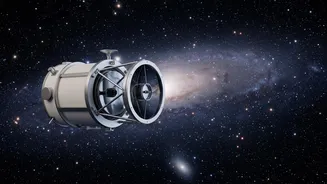
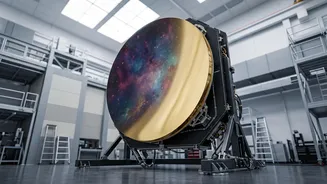
At the core of the Roman Telescope is its 2.4-meter (7.9-foot) primary mirror. This is the same size as the mirror on the Hubble Space Telescope, a detail that might seem underwhelming at first glance. However, its origins are fascinating—the mirror was originally built for a completely different purpose. It was donated to NASA by the U.S. National Reconnaissance Office, an agency that develops surveillance equipment. Though its initial mission was likely pointed toward Earth, it has been repurposed to gaze out at the distant universe. This recycled 'spy mirror' is significantly lighter than Hubble's, weighing about a quarter as much, which makes the entire spacecraft more agile and able to reposition itself quickly to survey new patches of sky.
A Wide-Angle Lens on the Universe
The true genius of Roman's mirror isn't its size, but its synergy with the telescope's main camera, the Wide Field Instrument (WFI). This combination gives Roman a field of view that is a staggering 100 times larger than Hubble's infrared camera. Imagine looking at the sky through a keyhole—that’s Hubble's deep but narrow view. Roman, by contrast, offers a massive bay window. In its initial five-year mission, Roman is expected to survey 50 times more sky than Hubble has in over 30 years of operation. This capability will allow it to create the first wide-field maps of the universe with space-based sharpness, capturing information from over a billion galaxies.
Different Goals, Different Tools
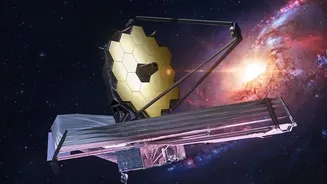
Roman is not a replacement for Hubble or Webb, but a powerful complement to them. Each telescope is optimized for a different task. Hubble excels at capturing ultra-sharp images in visible and ultraviolet light. Webb is a specialist in infrared light, allowing it to peer back to the dawn of time. Roman also observes in infrared light but is built for speed and scale. Its mirror is coated with a thin layer of silver to maximize reflectivity for near-infrared light, ideal for its survey work. In practice, Roman will act as a cosmic scout, identifying countless fascinating targets—from rogue planets to unusual galaxies—which the more focused Webb and Hubble can then investigate in greater detail.
The Search for New Worlds and Dark Energy
Roman's wide view is perfectly suited for its two primary science goals. First, it will conduct a massive census of exoplanets using a technique called gravitational microlensing. This method is sensitive enough to find planets down to the mass of Mars and even free-floating 'rogue planets' not tied to any star. Scientists expect Roman to discover over 100,000 new planets, dramatically expanding our catalogue of known worlds. Second, by mapping the distribution of galaxies and observing distant supernovae, Roman will help scientists understand the mysterious force known as dark energy, which is causing the expansion of the universe to accelerate. Its data will provide crucial clues about whether this force has changed over cosmic history.