


The High Stakes of Space Weather
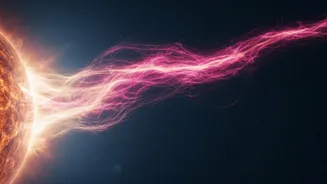
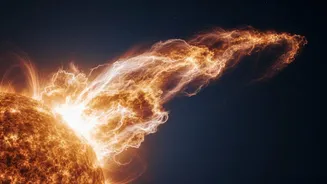
Space weather is not a distant, abstract concept; it has the potential for real-world consequences. The primary threat comes from coronal mass ejections (CMEs), which are colossal explosions of plasma and magnetic fields from the Sun's outer atmosphere.
When a CME is aimed at Earth, it can trigger a geomagnetic storm upon arrival. These storms can induce powerful electrical currents in long conductors like power lines, potentially overloading grids and causing widespread blackouts, as happened in Quebec in 1989. Satellites that power our GPS, communications, and weather forecasting are also vulnerable to damage from the high-energy particles carried by these storms. With modern society so deeply reliant on this technology, the ability to accurately forecast a CME's arrival is no longer a purely scientific pursuit—it is a critical aspect of infrastructure security.
A New Way of Seeing Storms
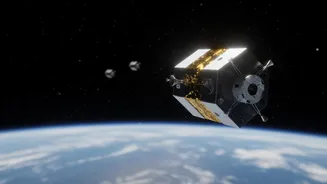
For decades, forecasting the arrival of a CME has been a significant challenge. Scientists using conventional instruments could typically only observe a CME for the first one-fifth of its journey from the Sun. After that, the storm would become effectively invisible, leaving forecasters to estimate its speed and trajectory over the remaining 120 million kilometres to Earth. This method often resulted in arrival time predictions with an error margin of five hours or more. The PUNCH mission—short for Polarimeter to Unify the Corona and Heliosphere—changes this entirely. Launched in March 2025, the mission consists of a constellation of four suitcase-sized satellites orbiting Earth. Working together, they act as a single, powerful observatory that can continuously track a CME's progress almost all the way to our planet, capturing a new image every four minutes.
From Hours of Uncertainty to Minutes
The key innovation of PUNCH is its ability to create a 3D view of a solar storm as it travels through space. This continuous, wide-field imagery allows scientists to see how the CME evolves, changes shape, and accelerates or decelerates due to its interaction with the ever-present solar wind. In a recent proof-of-concept test, scientists used PUNCH data from a CME that erupted on May 31, 2025. By feeding the images into a computer model, they were able to track the leading edge of the storm and predict its arrival at Earth. The result was a stunning success: the forecast was accurate to within 30 minutes, a massive improvement over the previous multi-hour window of uncertainty. This test demonstrates a revolutionary leap in forecasting capability, akin to, as one scientist put it, upgrading from a steam engine to a modern internal combustion engine.
Turning Data Into Actionable Warnings
This newfound precision is more than just an academic achievement. An accurate, timely warning allows critical infrastructure operators to take protective measures. With a reliable forecast, power grid managers can prepare to stabilize their networks against induced currents, satellite operators can put their spacecraft into a protective safe mode to prevent electronic damage, and airlines can reroute flights away from polar regions where radiation exposure and communication blackouts are more likely during a storm. The PUNCH mission's ability to provide this advance notice transforms space weather forecasting from a reactive science into a proactive tool for risk mitigation. The data from PUNCH's imagers, combined with increasingly sophisticated computer models, paves the way for a future where space weather alerts are as reliable and useful as hurricane warnings are today.