



The Universe's Cosmic Misfits
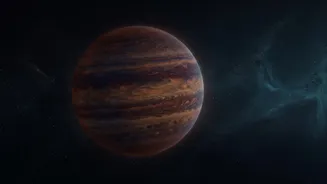
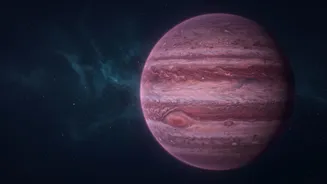
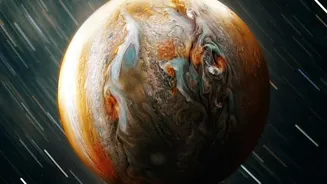
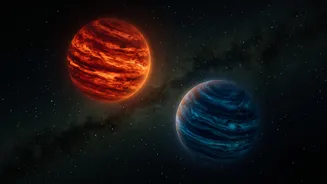
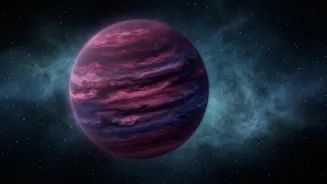
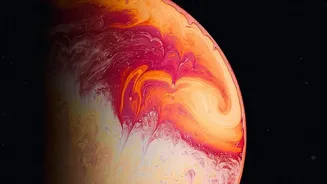
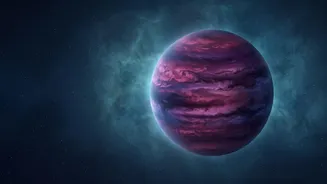
Brown dwarfs occupy a mysterious middle ground between the largest gas giant planets and the smallest stars. They form from the gravitational collapse of gas and dust clouds, much like stars do, but they never accumulate enough mass to ignite the sustained
hydrogen fusion that makes stars shine. Instead of becoming brilliant stellar furnaces, they are more like celestial embers, glowing dimly as they slowly cool over billions of years. With masses ranging from about 13 to 80 times that of Jupiter, they are too big to be considered planets but not quite massive enough to be stars. This unique status makes them fascinating laboratories for understanding both planetary and stellar atmospheric processes.
A Surprising Atmospheric Cocktail
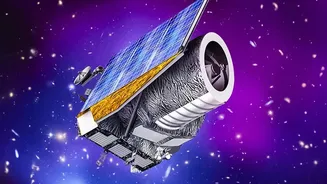
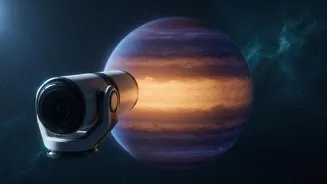
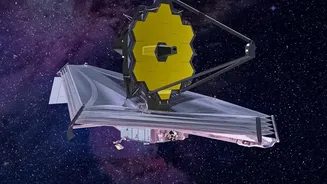
For a long time, models of brown dwarf atmospheres were based on theoretical calculations. Recently, however, NASA's SPHEREx space telescope has provided a much clearer view. By analysing the light from 37 nearby brown dwarfs, scientists have found chemically rich atmospheres containing a surprising mix of molecules, including water, carbon monoxide, carbon dioxide, and methane. The presence of both carbon dioxide (CO2) and methane (CH4) is particularly noteworthy. It points to a level of chemical complexity that current models have struggled to explain, suggesting that the atmospheres of these objects are much more dynamic than previously thought.
A New Eye on the Sky
The key to this discovery is spectroscopy, the science of breaking down light into its constituent colours. NASA's SPHEREx telescope measures the brightness of these objects in 102 different colours of infrared light, which is invisible to the human eye. Different molecules in an atmosphere absorb and emit light at very specific wavelengths, creating a unique 'fingerprint' or spectrum. By analysing these spectra, astronomers can deduce the chemical makeup of a brown dwarf's atmosphere from light-years away. This powerful technique has revealed that no two brown dwarfs are exactly alike; even those with similar temperatures can have distinctly different spectra, highlighting a surprising diversity.
Rewriting the Atmospheric Rulebook
The latest findings present a challenge to existing atmospheric models. While the models can generally predict the broad chemical trends as a brown dwarf cools, they fall short in explaining the finer details, especially during the transition phases where clouds of exotic minerals form and dissipate. For instance, as a brown dwarf cools, it goes through a stage where thick clouds of silicates and iron give way to a clearer, methane-rich atmosphere. The complex interplay of chemicals observed by SPHEREx suggests our understanding of the physics and chemistry at play, such as cloud formation and atmospheric circulation, is incomplete.
The Bigger Picture
Studying brown dwarfs isn't just about understanding these specific objects. Because they are often found in isolation, free from the overwhelming glare of a parent star, they serve as excellent proxies for understanding the atmospheres of gas giant exoplanets. The atmospheric complexity now being seen on brown dwarfs provides crucial insights that can be applied to the study of planets orbiting other stars. Discoveries like the unexpected methane emissions on some brown dwarfs, potentially caused by aurorae, further underscore how much we still have to learn. Each new observation helps astronomers refine their models, bringing us a step closer to understanding the vast diversity of worlds beyond our solar system.