


The Challenge of Lunar Gravity
Walking on the Moon isn't like the weightless floating we see on the International Space Station. The Moon has its own gravity, but it's only about one-sixth as strong as Earth's. This fractional gravity creates a bizarre environment where a 180-pound
person would feel like they weigh only 30 pounds. While that sounds liberating, it makes controlled movement incredibly difficult. Simple tasks like kneeling, picking up a rock, or even just walking without bouncing uncontrollably become major physical and logistical hurdles. Early spacewalks during the Gemini missions revealed that training on Earth was falling short, as astronauts struggled more than anticipated. This highlighted the need for a better way to prepare for working in an environment so fundamentally different from our own.
Creating the Moon in a Pool
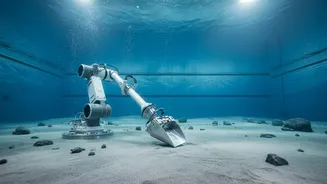
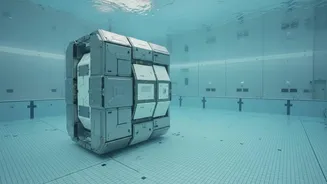
The solution lies at the bottom of the Neutral Buoyancy Laboratory (NBL) in Houston, Texas. This is no ordinary pool; it holds a staggering 6.2 million gallons of water and is large enough to contain full-scale mockups of spacecraft. The key principle at work is neutral buoyancy. By carefully adding a precise combination of weights and flotation devices to an astronaut's spacesuit, engineers can counteract the person's natural tendency to float or sink. They fine-tune this balance until the astronaut effectively feels like they weigh only one-sixth of their normal body weight, closely mimicking the sensation of being on the lunar surface. Support divers assist the astronauts, but the goal is to create a realistic simulation where they can practice complex tasks for hours at a time.
Training for the Artemis Generation
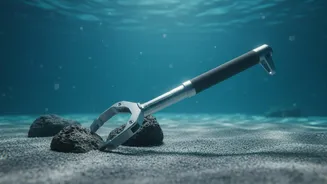
This underwater training is a cornerstone of NASA's Artemis program, which aims to return humans to the Moon for the first time since the Apollo era. At the bottom of the NBL, which has been transformed to resemble a lunar landscape with sand and rocks, astronauts practice the specific jobs they'll need to perform. This includes rehearsing how to use geological tools to collect samples, deploying scientific payloads, and learning to recover from a fall in a bulky, pressurized suit. A recent training session was the first time two geologists were suited up simultaneously to practice lunar science operations. They also train under specialized low-angle lighting that simulates the harsh shadows near the Moon's South Pole, a key target for future landings.
An Imperfect but Essential Simulation
While neutral buoyancy is the best tool available, it's not a perfect replica of the lunar environment. The most significant difference is water drag. Moving through water creates resistance, which doesn't exist in the vacuum of space. This can make some movements feel slower or require different techniques than on the actual Moon. Furthermore, while the suit is neutrally buoyant, the astronaut inside can still feel their own weight and the effects of Earth's gravity. Despite these limitations, the NBL provides the highest-fidelity environment on Earth for practicing long-duration spacewalks and developing the procedures that ensure astronaut safety and mission success. The timeline to complete a task underwater is often very similar to the time it takes in space, making it an invaluable planning tool.